Ch. 9 - Substitution and Elimination Reactions of Alkyl Halides
Bruice - Organic Chemistry 8th Edition
Bruice8th EditionOrganic ChemistryISBN: 9780135213711당신이 사용하는 게 아니라요?교과서 변경
9장, 문제 74a

Rank the following species in each set from best nucleophile to poorest nucleophile.
a. Chemical species CH3CO−, CH3CH2S−, CH3CH2O− in methanol, ranked from best to poorest nucleophile.

검증된 단계별 안내
1
Step 1: Understand the concept of nucleophilicity. Nucleophilicity refers to the ability of a species to donate a pair of electrons to an electrophile. Factors affecting nucleophilicity include charge, electronegativity, steric hindrance, and solvent effects.
Step 2: Analyze the charge of each species. Generally, negatively charged species are better nucleophiles than their neutral counterparts because they have a higher electron density available for donation.
Step 3: Consider electronegativity. Species with lower electronegativity are better nucleophiles because they hold onto their electrons less tightly, making them more available for bonding.
Step 4: Evaluate steric hindrance. Bulky groups around the nucleophilic center can hinder its ability to approach the electrophile, reducing nucleophilicity.
Step 5: Account for solvent effects. In polar protic solvents, nucleophilicity decreases for smaller ions due to hydrogen bonding, while in polar aprotic solvents, nucleophilicity is less affected by hydrogen bonding and depends more on charge and electronegativity.

비슷한 문제에 대한 검증된 영상 답변:

이 영상 해법은 위 문제에 도움이 된다고 튜터들이 추천한 것입니다.
영상 길이:
5m

주요 개념

질문에 올바르게 답하기 위해 반드시 이해해야 하는 핵심 개념들은 다음과 같습니다.

Nucleophilicity

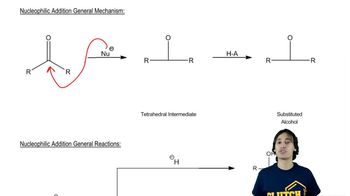
Nucleophilicity refers to the ability of a species to donate an electron pair to an electrophile during a chemical reaction. It is influenced by factors such as charge, electronegativity, and steric hindrance. Generally, negatively charged species are better nucleophiles than neutral ones, and less electronegative atoms are more nucleophilic due to their willingness to share electrons.
추천 영상:
08:27
Nucleophilic Addition

Solvent Effects

The solvent can significantly impact nucleophilicity. In polar protic solvents, nucleophiles are often stabilized by solvation, which can hinder their reactivity. Conversely, in polar aprotic solvents, nucleophiles are less solvated and can exhibit greater reactivity, making the choice of solvent crucial when ranking nucleophiles.
추천 영상:
01:16
Identification of polarity in solvents

Steric Hindrance

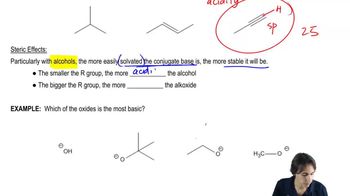
Steric hindrance refers to the crowding around a reactive site that can impede the approach of a nucleophile to an electrophile. Bulky groups attached to a nucleophile can reduce its ability to effectively collide with and react with an electrophile, thus affecting its nucleophilicity. Smaller, less hindered nucleophiles are generally more effective in nucleophilic attacks.
추천 영상:
02:53
Understanding steric effects.