Ch. 9 - Substitution and Elimination Reactions of Alkyl Halides
Bruice - Organic Chemistry 8th Edition
Bruice8th EditionOrganic ChemistryISBN: 9780135213711당신이 사용하는 게 아니라요?교과서 변경
9장, 문제 15c,d

What is the product of the reaction of bromoethane with each of the following nucleophiles?
c. (CH3)3N
d. CH3CH2S-

검증된 단계별 안내
1
Step 1: Identify the type of reaction. Bromoethane (C2H5Br) is a primary alkyl halide, and the reaction with nucleophiles typically proceeds via an SN2 mechanism due to the unhindered nature of the carbon attached to the bromine atom.
Step 2: Analyze the nucleophile in part (c). The nucleophile is trimethylamine ((CH3)3N), which is a neutral nucleophile with a lone pair of electrons on the nitrogen atom. In this case, the reaction will likely result in the formation of a quaternary ammonium salt through nucleophilic substitution.
Step 3: Write the reaction for part (c). The nitrogen in (CH3)3N attacks the carbon bonded to the bromine in bromoethane, displacing the bromide ion (Br⁻) and forming a quaternary ammonium salt: [(CH3)3N⁺CH2CH3]Br⁻.
Step 4: Analyze the nucleophile in part (d). The nucleophile is ethanethiolate (CH3CH2S⁻), which is a strong nucleophile due to the negatively charged sulfur atom. This nucleophile will also undergo an SN2 reaction with bromoethane.
Step 5: Write the reaction for part (d). The sulfur atom in CH3CH2S⁻ attacks the carbon bonded to the bromine in bromoethane, displacing the bromide ion (Br⁻) and forming the product CH3CH2SCH2CH3 (ethyl ethyl sulfide).

비슷한 문제에 대한 검증된 영상 답변:

이 영상 해법은 위 문제에 도움이 된다고 튜터들이 추천한 것입니다.
영상 길이:
3m

주요 개념

질문에 올바르게 답하기 위해 반드시 이해해야 하는 핵심 개념들은 다음과 같습니다.

Nucleophilicity

Nucleophilicity refers to the ability of a species to donate an electron pair to an electrophile, forming a chemical bond. Strong nucleophiles, such as thiolates or amines, are more likely to react with electrophiles like bromoethane. The strength of a nucleophile is influenced by factors such as charge, electronegativity, and steric hindrance.
추천 영상:
08:27
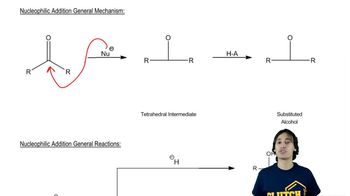
Nucleophilic Addition

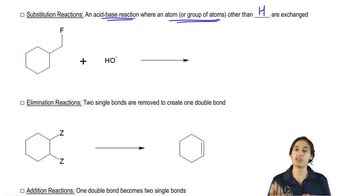
Substitution Reactions

Substitution reactions involve the replacement of one functional group in a molecule with another. In the case of bromoethane, nucleophiles can perform either an SN1 or SN2 mechanism, depending on their structure and the conditions. Understanding these mechanisms is crucial for predicting the products of the reaction.
추천 영상:
01:34
Recognizing Substitution Reactions.

Steric Hindrance

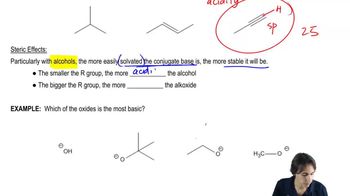
Steric hindrance refers to the prevention of reactions due to the spatial arrangement of atoms within a molecule. In nucleophilic substitution, bulky nucleophiles like (CH3)3N may experience steric hindrance, affecting their ability to approach and react with the electrophile. This concept is essential for determining the reaction pathway and product formation.
추천 영상:
02:53
Understanding steric effects.