Ch. 9 - Substitution and Elimination Reactions of Alkyl Halides
Bruice - Organic Chemistry 8th Edition
Bruice8th EditionOrganic ChemistryISBN: 9780135213711당신이 사용하는 게 아니라요?교과서 변경
9장, 문제 70h

What nucleophiles would form the following compounds as a result of reacting with 1-iodobutane?
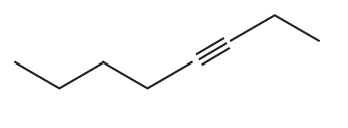
h. Chemical structures illustrating nucleophiles reacting with 1-iodobutane in an SN2 reaction context.

검증된 단계별 안내
1
Step 1: Analyze the given compound structure. The compound shown contains a nitrile group (-C≡N) attached to a butane chain. This indicates that the nucleophile used in the reaction must have introduced the nitrile group.
Step 2: Recall the mechanism of nucleophilic substitution reactions. 1-Iodobutane is a primary alkyl halide, which typically undergoes SN2 reactions. In an SN2 reaction, the nucleophile attacks the carbon bonded to the leaving group (iodine) in a single step, displacing the leaving group.
Step 3: Identify the nucleophile that can introduce the nitrile group. The nucleophile in this case would be the cyanide ion (CN⁻), as it contains the nitrile group and is a strong nucleophile capable of participating in an SN2 reaction.
Step 4: Write the reaction mechanism. The cyanide ion (CN⁻) attacks the carbon atom bonded to iodine in 1-iodobutane, forming a new bond between the carbon and the cyanide group while displacing iodine as the leaving group.
Step 5: Summarize the reaction. The nucleophile required to form the given compound from 1-iodobutane is the cyanide ion (CN⁻). The reaction proceeds via an SN2 mechanism, resulting in the substitution of the iodine atom with the nitrile group.

비슷한 문제에 대한 검증된 영상 답변:

이 영상 해법은 위 문제에 도움이 된다고 튜터들이 추천한 것입니다.
영상 길이:
3m

주요 개념

질문에 올바르게 답하기 위해 반드시 이해해야 하는 핵심 개념들은 다음과 같습니다.

Nucleophiles

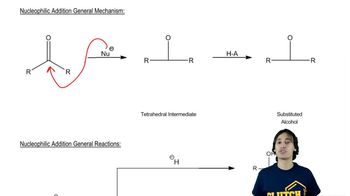
Nucleophiles are species that donate an electron pair to form a chemical bond in a reaction. They are typically negatively charged or neutral molecules with lone pairs of electrons. In the context of organic reactions, nucleophiles attack electrophiles, which are electron-deficient species. Common examples include hydroxide ions (OH⁻), alkoxides (RO⁻), and amines (RNH₂).
추천 영상:
08:27
Nucleophilic Addition

SN2 Reaction Mechanism

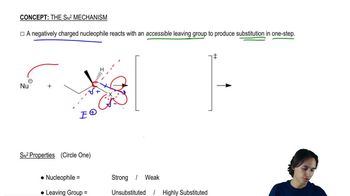
The SN2 (substitution nucleophilic bimolecular) reaction is a type of nucleophilic substitution where the nucleophile attacks the electrophile simultaneously as the leaving group departs. This mechanism involves a single concerted step, leading to the inversion of configuration at the carbon center. It is favored by primary and some secondary alkyl halides, such as 1-iodobutane, due to steric accessibility.
추천 영상:
08:33
Drawing the SN2 Mechanism

Leaving Groups

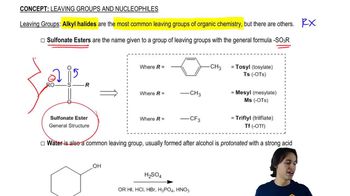
Leaving groups are atoms or groups that can depart from the parent molecule during a chemical reaction, allowing for the formation of new bonds. A good leaving group is typically stable after departure, which is often the case for halides like iodide (I⁻). In SN2 reactions, the quality of the leaving group significantly influences the reaction rate, with better leaving groups facilitating faster reactions.
추천 영상:
07:22
The 3 important leaving groups to know.