Ch. 10 - Alkynes: Electrophilic Addition and Redox Reactions
Mullins - Organic Chemistry: A Learner Centered Approach 1st Edition
Mullins1st EditionOrganic Chemistry: A Learner Centered ApproachISBN: 9780137566471당신이 사용하는 게 아니라요?교과서 변경
9장, 문제 38

Draw the ketone(s) you would expect to form by treating the following alkynes under the conditions of hydroboration–oxidation: (a) 6-methyloct-1-yne, (b) 1,10-dicyclohexyldec-5-yne, and (c) 5-phenylhex-2-yne.
<IMAGE>

검증된 단계별 안내
1
Step 1: Understand the reaction mechanism. Hydroboration–oxidation of alkynes involves the addition of borane (BH₃) to the triple bond, followed by oxidation with hydrogen peroxide (H₂O₂) in the presence of sodium hydroxide (NaOH). This reaction converts the alkyne into a ketone via anti-Markovnikov addition.
Step 2: Analyze the structure of the alkyne. For each alkyne provided, identify the triple bond and determine the regioselectivity of the reaction. Hydroboration–oxidation typically results in the formation of a ketone at the less substituted carbon of the triple bond.
Step 3: For (a) 6-methyloct-1-yne, locate the triple bond between carbons 1 and 2. The hydroboration–oxidation will yield a ketone at the terminal carbon (C1), as it is less substituted. Draw the resulting ketone structure.
Step 4: For (b) 1,10-dicyclohexyldec-5-yne, locate the triple bond between carbons 5 and 6. The hydroboration–oxidation will yield a ketone at carbon 5, as it is less substituted compared to carbon 6. Draw the resulting ketone structure.
Step 5: For (c) 5-phenylhex-2-yne, locate the triple bond between carbons 2 and 3. The hydroboration–oxidation will yield a ketone at carbon 2, as it is less substituted compared to carbon 3. Draw the resulting ketone structure.

비슷한 문제에 대한 검증된 영상 답변:

이 영상 해법은 위 문제에 도움이 된다고 튜터들이 추천한 것입니다.
영상 길이:
6m

주요 개념

질문에 올바르게 답하기 위해 반드시 이해해야 하는 핵심 개념들은 다음과 같습니다.

Hydroboration-Oxidation

Hydroboration-oxidation is a two-step reaction process used to convert alkynes into carbonyl compounds, specifically ketones or aldehydes. In the first step, borane (BH₃) adds across the triple bond of the alkyne, forming a trialkylborane intermediate. The second step involves oxidation with hydrogen peroxide (H₂O₂) and a base (NaOH), which converts the boron atom into a hydroxyl group, yielding the corresponding ketone or aldehyde.
추천 영상:
06:38
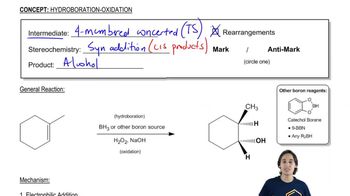
General properties of hydroboration-oxidation.

Alkyne Reactivity

Alkynes are hydrocarbons containing a carbon-carbon triple bond, which makes them highly reactive. Their reactivity allows them to undergo various addition reactions, including hydroboration. The position of the triple bond and the substituents on the alkyne influence the regioselectivity of the reaction, determining whether a ketone or aldehyde is formed after oxidation.
추천 영상:
09:11
Alkyne Hydration

Regioselectivity

Regioselectivity refers to the preference of a chemical reaction to yield one structural isomer over others when multiple products are possible. In the context of hydroboration-oxidation of alkynes, the regioselectivity is influenced by the sterics and electronics of the substituents on the alkyne. This concept is crucial for predicting the specific ketone products formed from the given alkynes in the question.
추천 영상:
05:09
Heck Reaction