Ch. 10 - Alkynes: Electrophilic Addition and Redox Reactions
Mullins - Organic Chemistry: A Learner Centered Approach 1st Edition
Mullins1st EditionOrganic Chemistry: A Learner Centered ApproachISBN: 9780137566471당신이 사용하는 게 아니라요?교과서 변경
9장, 문제 24b

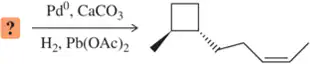
Hydrogenation of which alkynes would produce the following cis-alkenes?
(b) Chemical reaction diagram showing hydrogenation conditions for producing cis-alkenes from alkynes.

검증된 단계별 안내
1
Step 1: Analyze the reaction conditions provided in the image. The reagents include Pd⁰ (Palladium catalyst), CaCO₃ (calcium carbonate), H₂ (hydrogen gas), and Pb(OAc)₂ (lead acetate). These are the typical components of the Lindlar catalyst, which is used for selective hydrogenation of alkynes to cis-alkenes.
Step 2: Understand the product structure shown in the image. The product is a cis-alkene with a cyclobutyl group attached to a chain containing a double bond. The stereochemistry of the double bond is cis, meaning both substituents are on the same side of the double bond.
Step 3: Recall that the Lindlar catalyst selectively hydrogenates alkynes to cis-alkenes without further reducing the alkene to an alkane. Therefore, the starting material must be an alkyne that corresponds to the product structure.
Step 4: Deduce the structure of the alkyne precursor. To form the cis-alkene shown, the alkyne must have the same carbon skeleton as the product, but with a triple bond in place of the double bond. The triple bond should be located where the double bond is in the product.
Step 5: Write the structure of the alkyne precursor. Replace the cis double bond in the product with a triple bond, ensuring the rest of the molecule remains unchanged. This alkyne, when subjected to the Lindlar catalyst, will produce the given cis-alkene.

비슷한 문제에 대한 검증된 영상 답변:

이 영상 해법은 위 문제에 도움이 된다고 튜터들이 추천한 것입니다.
영상 길이:
2m

주요 개념

질문에 올바르게 답하기 위해 반드시 이해해야 하는 핵심 개념들은 다음과 같습니다.

Hydrogenation of Alkynes

Hydrogenation is a chemical reaction that involves the addition of hydrogen (H2) to an unsaturated compound, such as an alkyne, to convert it into a saturated compound, like an alkene or alkane. In the case of alkynes, the reaction can yield cis-alkenes when specific catalysts and conditions are used, such as using Lindlar's catalyst, which selectively hydrogenates alkynes to cis-alkenes.
추천 영상:
03:46
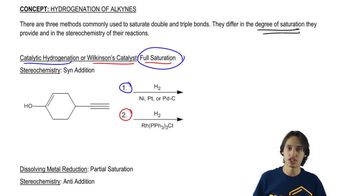
Using Catalytic hydrogenation or Wilkinson’s Catalyst to turn alkynes to alkanes.

Lindlar's Catalyst

Lindlar's catalyst is a palladium-based catalyst that is used to facilitate the partial hydrogenation of alkynes to cis-alkenes. It consists of palladium (Pd) deposited on calcium carbonate (CaCO3) and is often poisoned with lead acetate (Pb(OAc)2) to prevent complete hydrogenation to alkanes. This selective hydrogenation is crucial for producing specific stereoisomers in organic synthesis.
추천 영상:
가이드 코스
2:10
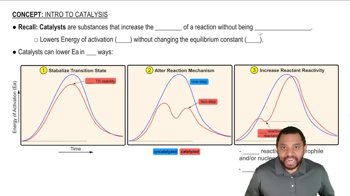
Introduction to Catalysis Concept 1

Stereochemistry of Alkenes

Stereochemistry refers to the spatial arrangement of atoms in molecules and how this affects their chemical behavior. In the case of alkenes, the cis and trans configurations arise from the restricted rotation around the double bond. Understanding the stereochemistry is essential for predicting the properties and reactivity of the resulting alkenes from hydrogenation reactions, particularly in the context of synthesis and biological activity.
추천 영상:
가이드 코스
1:38
Polymer Stereochemistry Concept 1