Ch. 10 - Alkynes: Electrophilic Addition and Redox Reactions
Mullins - Organic Chemistry: A Learner Centered Approach 1st Edition
Mullins1st EditionOrganic Chemistry: A Learner Centered ApproachISBN: 9780137566471당신이 사용하는 게 아니라요?교과서 변경
9장, 문제 60

In 1973, Caine and Tuller reported a synthesis of racemic oplapanone, a sesquiterpene isolated from Oplopanax japonicus (a deciduous shrub) involving a reaction we learned in this chapter. Predict the product of the reaction shown. (Caine, D.; Tuller, F. N. J. Org. Chem. 1973, 38, 3663.)

검증된 단계별 안내
1
Step 1: Analyze the reaction conditions. The reagents Hg²⁺, HgSO₄, and H₂O indicate that this is a hydration reaction of an alkyne, specifically oxymercuration-demercuration. This reaction typically converts an alkyne into a ketone via Markovnikov addition of water.
Step 2: Identify the functional group undergoing the reaction. The molecule contains a terminal alkyne group (-C≡CH) attached to a bicyclic structure. This alkyne will react with the Hg²⁺ catalyst and water to form a ketone.
Step 3: Predict the intermediate. In the presence of Hg²⁺, the alkyne undergoes electrophilic addition to form a mercurinium ion intermediate. Water then attacks the more substituted carbon of the alkyne, leading to the formation of an enol intermediate.
Step 4: Tautomerization of the enol. The enol intermediate undergoes keto-enol tautomerization, which is acid-catalyzed, to yield the final ketone product. The ketone will form at the more substituted carbon due to Markovnikov addition.
Step 5: Consider stereochemistry and the bicyclic structure. The reaction does not affect the stereochemistry of the other groups in the molecule, such as the hydroxyl group and methyl groups. The ketone will be incorporated into the bicyclic structure at the position of the original alkyne.

비슷한 문제에 대한 검증된 영상 답변:

이 영상 해법은 위 문제에 도움이 된다고 튜터들이 추천한 것입니다.

주요 개념

질문에 올바르게 답하기 위해 반드시 이해해야 하는 핵심 개념들은 다음과 같습니다.

Synthesis of Sesquiterpenes

Sesquiterpenes are a class of terpenes consisting of three isoprene units, resulting in a 15-carbon structure. Understanding their synthesis involves recognizing the specific reactions and mechanisms that can form these complex molecules. The synthesis often includes cyclization and rearrangement reactions, which are crucial for constructing the unique carbon skeletons characteristic of sesquiterpenes.
추천 영상:
가이드 코스
1:16
Synthesis of Amino Acids: Strecker Synthesis Example 1

Racemic Mixtures

A racemic mixture contains equal amounts of two enantiomers, which are molecules that are mirror images of each other. In organic synthesis, producing a racemic mixture can occur when a reaction does not favor one enantiomer over the other, leading to a 50/50 distribution. Understanding the implications of racemic mixtures is essential for predicting the properties and reactivity of the synthesized compound.
추천 영상:
03:08
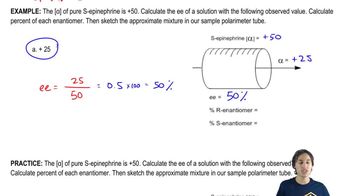
Calculating EE, percent of each enantiomer, and sketching mixture

Reaction Mechanisms

Reaction mechanisms describe the step-by-step process by which reactants transform into products, detailing the bond-breaking and bond-forming events. Familiarity with common mechanisms, such as nucleophilic substitutions or electrophilic additions, is vital for predicting the outcome of a given reaction. Analyzing the mechanism helps in understanding how specific conditions or reagents influence the final product.
추천 영상:
02:16
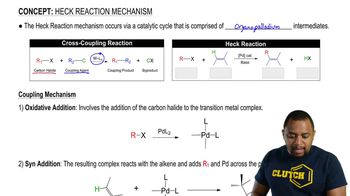
Heck Reaction Mechanism