Ch. 10 - Alkynes: Electrophilic Addition and Redox Reactions
Mullins - Organic Chemistry: A Learner Centered Approach 1st Edition
Mullins1st EditionOrganic Chemistry: A Learner Centered ApproachISBN: 9780137566471당신이 사용하는 게 아니라요?교과서 변경
9장, 문제 19c

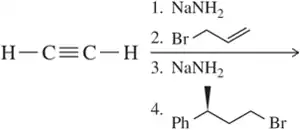
Predict the product of the following acetylide alkylations.
(c) Chemical reaction sequence illustrating acetylide alkylation with sodium amide and bromine, leading to a product with a phenyl group.

검증된 단계별 안내
1
Step 1: Understand the reaction mechanism. Acetylide alkylation involves the reaction of a terminal alkyne with a strong base to form an acetylide ion, followed by the reaction of the acetylide ion with an alkyl halide to form a new carbon-carbon bond.
Step 2: Deprotonate the terminal alkyne. Use a strong base, such as sodium amide (NaNH₂), to remove the acidic proton from the terminal alkyne, forming the acetylide ion. Represent this step as: R-C≡CH+NaNH2→R-C≡C-Na++NH3.
Step 3: Identify the alkyl halide. The acetylide ion will act as a nucleophile and attack the electrophilic carbon of the alkyl halide, displacing the halide ion (a substitution reaction). Ensure the alkyl halide is a primary or methyl halide to avoid side reactions like elimination.
Step 4: Perform the nucleophilic substitution. The acetylide ion reacts with the alkyl halide to form a new carbon-carbon bond. Represent this step as: R-C≡C-Na++R'X→R-C≡CR'+NaX, where R' is the alkyl group and X is the halide.
Step 5: Predict the product. Combine the acetylide ion and the alkyl group from the alkyl halide to form the final product, which is an alkyne with the new carbon-carbon bond. Ensure the structure of the product reflects the substitution reaction accurately.

비슷한 문제에 대한 검증된 영상 답변:

이 영상 해법은 위 문제에 도움이 된다고 튜터들이 추천한 것입니다.
영상 길이:
5m

주요 개념

질문에 올바르게 답하기 위해 반드시 이해해야 하는 핵심 개념들은 다음과 같습니다.

Acetylide Ion

An acetylide ion is a negatively charged species formed by the deprotonation of terminal alkynes. It is a strong nucleophile, capable of attacking electrophiles in nucleophilic substitution reactions. Understanding the structure and reactivity of acetylide ions is crucial for predicting the outcomes of alkylation reactions.
추천 영상:
가이드 코스
3:39
Metal Ion Catalysis Concept 1

Nucleophilic Substitution

Nucleophilic substitution is a fundamental reaction mechanism in organic chemistry where a nucleophile replaces a leaving group in a molecule. This process can occur via two main pathways: SN1 and SN2. The mechanism chosen depends on factors such as the structure of the substrate and the nature of the nucleophile and leaving group.
추천 영상:
01:47
Nucleophiles and Electrophiles can react in Substitution Reactions.

Alkylation Reaction

Alkylation reactions involve the introduction of an alkyl group into a molecule, often through the reaction of a nucleophile with an alkyl halide. In the context of acetylide alkylation, the acetylide ion acts as the nucleophile, attacking the electrophilic carbon of the alkyl halide, leading to the formation of a new carbon-carbon bond.
추천 영상:
03:19
Sodium Alkynide Alkylation