Ch. 10 - Alkynes: Electrophilic Addition and Redox Reactions
Mullins - Organic Chemistry: A Learner Centered Approach 1st Edition
Mullins1st EditionOrganic Chemistry: A Learner Centered ApproachISBN: 9780137566471당신이 사용하는 게 아니라요?교과서 변경
9장, 문제 25c

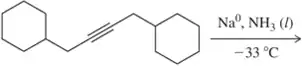
Predict the product of the following alkyne reductions.
(c) Chemical structure showing an alkyne with sodium and ammonia conditions for reduction at -33°C.

검증된 단계별 안내
1
Identify the type of reduction being performed on the alkyne. Common reduction methods include catalytic hydrogenation, Lindlar's catalyst, and dissolving metal reduction. Each method leads to a different product (alkane, cis-alkene, or trans-alkene).
Determine the reagents used in the reaction. For example, if the reaction uses H₂ with a metal catalyst like Pd/C, it will fully reduce the alkyne to an alkane. If Lindlar's catalyst is used, it will selectively reduce the alkyne to a cis-alkene. If Na in liquid NH₃ is used, it will reduce the alkyne to a trans-alkene.
Analyze the structure of the starting alkyne. Note whether it is a terminal alkyne (with a triple bond at the end of the chain) or an internal alkyne (with the triple bond between two carbons in the chain). This will help you predict the stereochemistry and regiochemistry of the product.
Write the mechanism for the reduction process. For example, in the case of Lindlar's catalyst, the reaction proceeds via syn-addition of hydrogen to the alkyne, resulting in a cis-alkene. For dissolving metal reduction, the reaction proceeds via anti-addition of hydrogen, resulting in a trans-alkene.
Draw the final product based on the type of reduction and the stereochemistry of the reaction. Ensure that the product matches the expected outcome based on the reagents and conditions used.

비슷한 문제에 대한 검증된 영상 답변:

이 영상 해법은 위 문제에 도움이 된다고 튜터들이 추천한 것입니다.
영상 길이:
57s

주요 개념

질문에 올바르게 답하기 위해 반드시 이해해야 하는 핵심 개념들은 다음과 같습니다.

Alkyne Reduction

Alkyne reduction refers to the chemical process of converting alkynes, which are hydrocarbons containing a carbon-carbon triple bond, into alkenes or alkanes. This transformation can be achieved through various methods, including catalytic hydrogenation, where hydrogen gas is added in the presence of a catalyst, or through the use of metal hydrides. The specific conditions and reagents used will determine the final product of the reduction.
추천 영상:
04:40
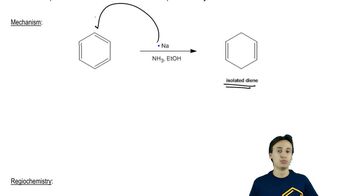
Birch Reduction Mechanism

Catalytic Hydrogenation

Catalytic hydrogenation is a reaction where hydrogen is added to an unsaturated compound, such as an alkyne, in the presence of a catalyst, typically palladium, platinum, or nickel. This process effectively reduces the triple bond to a double bond (alkene) or a single bond (alkane), depending on the extent of hydrogenation. The choice of catalyst and reaction conditions can influence the selectivity and rate of the reaction.
추천 영상:
05:21
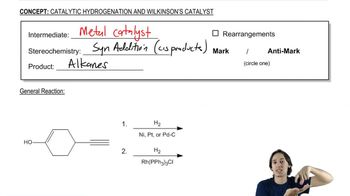
General properties of catalytic hydrogenation.

Regioselectivity in Reductions

Regioselectivity refers to the preference of a chemical reaction to occur at one location over another in a molecule. In the context of alkyne reductions, regioselectivity can be important when dealing with substituted alkynes, as the position of substituents can influence the outcome of the reduction. Understanding regioselectivity helps predict which product will be favored in reactions involving complex alkynes.
추천 영상:
07:12
Reductive Amination