Ch. 10 - Alkynes: Electrophilic Addition and Redox Reactions
Mullins - Organic Chemistry: A Learner Centered Approach 1st Edition
Mullins1st EditionOrganic Chemistry: A Learner Centered ApproachISBN: 9780137566471당신이 사용하는 게 아니라요?교과서 변경
9장, 문제 45a

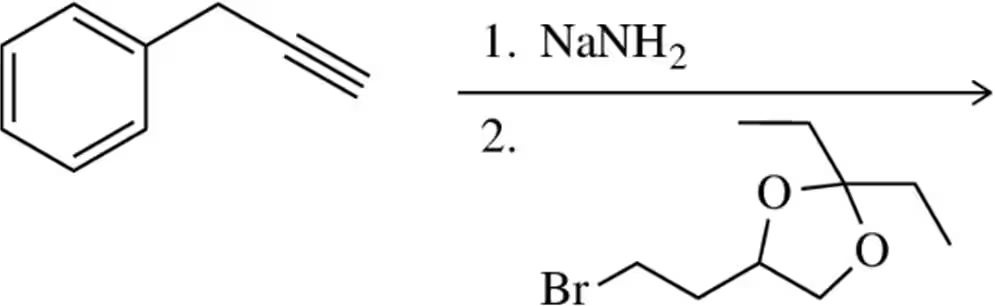
Show the products of the following acetylide alkylation reactions. [Make sure your product has the correct number of carbons.]
(a) Chemical reaction diagram showing acetylide alkylation with reactants and products labeled.

검증된 단계별 안내
1
Step 1: Understand the concept of acetylide alkylation. Acetylide ions (R-C≡C⁻) are strong nucleophiles that can attack alkyl halides (R-X) in an SN2 reaction, leading to the formation of a new carbon-carbon bond.
Step 2: Identify the acetylide ion and the alkyl halide in the reaction. The acetylide ion is typically generated from a terminal alkyne (R-C≡CH) by deprotonation using a strong base like NaNH₂ or NaH.
Step 3: Write the mechanism of the SN2 reaction. The acetylide ion attacks the carbon atom bonded to the halogen in the alkyl halide, displacing the halide ion (X⁻) and forming a new bond between the acetylide carbon and the alkyl group.
Step 4: Count the number of carbons in the product. Add the number of carbons in the acetylide ion to the number of carbons in the alkyl halide to ensure the product has the correct number of carbons.
Step 5: Draw the structure of the product. Combine the acetylide group (R-C≡C⁻) with the alkyl group from the alkyl halide, ensuring the triple bond remains intact and the connectivity is correct.

비슷한 문제에 대한 검증된 영상 답변:

이 영상 해법은 위 문제에 도움이 된다고 튜터들이 추천한 것입니다.
영상 길이:
2m

주요 개념

질문에 올바르게 답하기 위해 반드시 이해해야 하는 핵심 개념들은 다음과 같습니다.

Acetylide Ion

An acetylide ion is a negatively charged species formed by deprotonating a terminal alkyne. It is a strong nucleophile, capable of attacking electrophiles in nucleophilic substitution reactions. Understanding how to generate and utilize acetylide ions is crucial for performing alkylation reactions effectively.
추천 영상:
가이드 코스
3:39
Metal Ion Catalysis Concept 1

Nucleophilic Substitution

Nucleophilic substitution is a fundamental reaction mechanism in organic chemistry where a nucleophile replaces a leaving group in a molecule. In the context of acetylide alkylation, the acetylide ion acts as the nucleophile, attacking an alkyl halide to form a new carbon-carbon bond. This process is essential for extending carbon chains in organic synthesis.
추천 영상:
01:47
Nucleophiles and Electrophiles can react in Substitution Reactions.

Carbon Count in Products

Maintaining the correct number of carbons in the product is vital in organic synthesis, as it ensures the integrity of the molecular structure. In acetylide alkylation, the number of carbons in the starting materials and the alkyl halide must be accounted for to predict the final product accurately. This concept is crucial for verifying the success of the reaction and understanding the resulting compound's properties.
추천 영상:
07:07
Electron Counting