Ch. 10 - Alkynes: Electrophilic Addition and Redox Reactions
Mullins - Organic Chemistry: A Learner Centered Approach 1st Edition
Mullins1st EditionOrganic Chemistry: A Learner Centered ApproachISBN: 9780137566471당신이 사용하는 게 아니라요?교과서 변경
9장, 문제 5

The following reaction gives two different constitutional isomers in nearly equal yields. Why doesn't this reaction produce only one product?

검증된 단계별 안내
1
Identify the type of reaction: The reaction involves the addition of HCl to an alkene, which is a typical electrophilic addition reaction.
Examine the structure of the alkene: The alkene is 2-methyl-2-butene, which has a double bond between the second and third carbon atoms. This structure allows for the formation of two different carbocations.
Consider the formation of carbocations: When HCl adds to the alkene, the π bond electrons attack the hydrogen atom, leading to the formation of a carbocation. The carbocation can form at either the second or third carbon, resulting in two different intermediates.
Analyze the stability of carbocations: Both carbocations formed are tertiary, which are relatively stable due to hyperconjugation and inductive effects from the surrounding alkyl groups. This stability allows both carbocations to form nearly equally.
Determine the final products: Each carbocation can react with the chloride ion to form a different constitutional isomer. The nearly equal stability of the carbocations leads to the formation of two different products in nearly equal yields.

비슷한 문제에 대한 검증된 영상 답변:

이 영상 해법은 위 문제에 도움이 된다고 튜터들이 추천한 것입니다.

주요 개념

질문에 올바르게 답하기 위해 반드시 이해해야 하는 핵심 개념들은 다음과 같습니다.

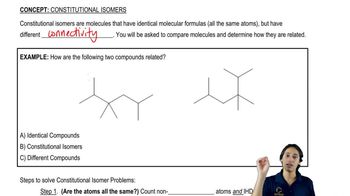
Constitutional Isomers

Constitutional isomers are compounds that have the same molecular formula but differ in the connectivity of their atoms. This means that the atoms are arranged in different ways, leading to distinct chemical structures and properties. Understanding constitutional isomers is crucial for analyzing reactions that yield multiple products, as it highlights how variations in structure can arise from the same reactants.
추천 영상:
01:10
What is a constitutional isomer?

Reaction Mechanism

A reaction mechanism describes the step-by-step process by which reactants are converted into products. It includes the formation and breaking of bonds, the transition states, and the intermediates involved. Knowing the mechanism helps explain why a reaction can lead to multiple products, as different pathways may lead to different isomers being formed simultaneously.
추천 영상:
02:16
Heck Reaction Mechanism

Equilibrium and Reaction Conditions

The conditions under which a reaction occurs, such as temperature, pressure, and concentration, can influence the formation of products. In some cases, reactions can reach a state of equilibrium where multiple products are formed and exist in a dynamic balance. This concept is essential for understanding why a reaction might yield two constitutional isomers in nearly equal amounts rather than a single product.
추천 영상:
04:00
Determining Acid/Base Equilibrium