Ch. 11 - Properties and Synthesis of Alkyl Halides: Radical Reactions
Mullins - Organic Chemistry: A Learner Centered Approach 1st Edition
Mullins1st EditionOrganic Chemistry: A Learner Centered ApproachISBN: 9780137566471당신이 사용하는 게 아니라요?교과서 변경
10장, 문제 27b

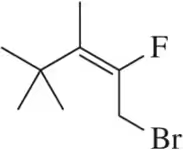
Identify the allylic carbon(s) in the following molecules.
(b) Structural diagram of a molecule with fluorine and bromine substituents, highlighting allylic carbon positions.

검증된 단계별 안내
1
Step 1: Understand the concept of allylic carbons. Allylic carbons are the carbons directly adjacent to a carbon-carbon double bond. These carbons are bonded to the sp2-hybridized carbon of the double bond and are often involved in resonance stabilization.
Step 2: Locate the carbon-carbon double bond in the molecule. In the given structure, the double bond is present between two carbons in the central part of the molecule.
Step 3: Identify the carbons directly adjacent to the double bond. These are the carbons bonded to the sp2-hybridized carbons of the double bond. Look for single bonds connecting to the double-bonded carbons.
Step 4: Examine the structure carefully. The carbon on the left of the double bond and the carbon on the right of the double bond are both allylic carbons because they are directly adjacent to the double bond.
Step 5: Verify the substituents attached to the allylic carbons. The allylic carbon on the left has a methyl group attached, while the allylic carbon on the right has a bromine atom attached. This confirms their positions as allylic carbons.

비슷한 문제에 대한 검증된 영상 답변:

이 영상 해법은 위 문제에 도움이 된다고 튜터들이 추천한 것입니다.
영상 길이:
57s

주요 개념

질문에 올바르게 답하기 위해 반드시 이해해야 하는 핵심 개념들은 다음과 같습니다.

Allylic Carbons

Allylic carbons are the carbon atoms that are directly adjacent to a carbon-carbon double bond. In organic chemistry, these carbons are significant because they can participate in various reactions, such as allylic substitutions, due to their unique reactivity. Identifying allylic carbons is crucial for understanding reaction mechanisms and predicting the outcomes of chemical reactions.
추천 영상:
00:48
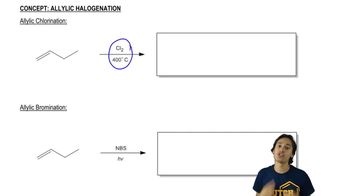
The products of Allylic Chlorination.

Structural Representation of Molecules

The structural representation of molecules, such as Lewis structures or skeletal formulas, provides a visual way to understand the arrangement of atoms and bonds within a compound. This representation helps in identifying functional groups, stereochemistry, and specific carbon types, including allylic carbons. A clear understanding of these structures is essential for analyzing chemical behavior and reactivity.
추천 영상:
05:09
Representations of L-Configuration

Reactivity of Allylic Positions

The reactivity of allylic positions is a key concept in organic chemistry, as these positions can undergo various reactions, including nucleophilic substitutions and radical reactions. The presence of a double bond near the allylic carbon increases its reactivity due to the stability of the resulting intermediates. Understanding this reactivity is important for predicting how molecules will behave in chemical reactions.
추천 영상:
가이드 코스
1:26
Reactions at the Allylic Position Concept 1