Ch. 11 - Properties and Synthesis of Alkyl Halides: Radical Reactions
Mullins - Organic Chemistry: A Learner Centered Approach 1st Edition
Mullins1st EditionOrganic Chemistry: A Learner Centered ApproachISBN: 9780137566471당신이 사용하는 게 아니라요?교과서 변경
10장, 문제 42a

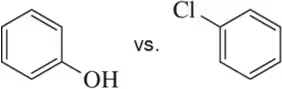
In each pair, (i) choose the compound that is most soluble in water. (ii) Within each pair, which is most soluble in nonpolar solvents?
(a) Chemical structures of phenol (OH) and chlorobenzene (Cl) for solubility comparison in water and nonpolar solvents.

검증된 단계별 안내
1
Step 1: Analyze the functional groups in each compound. The first compound contains a hydroxyl group (-OH), which is polar and capable of forming hydrogen bonds with water. The second compound contains a chlorine atom (-Cl), which is less polar and cannot form hydrogen bonds as effectively as the hydroxyl group.
Step 2: Consider the solubility in water. Compounds with polar functional groups and the ability to form hydrogen bonds are generally more soluble in water. Therefore, the compound with the hydroxyl group (-OH) is expected to be more soluble in water.
Step 3: Consider the solubility in nonpolar solvents. Nonpolar solvents dissolve compounds that are less polar or nonpolar due to the principle 'like dissolves like.' The compound with the chlorine atom (-Cl) is less polar than the compound with the hydroxyl group (-OH), making it more soluble in nonpolar solvents.
Step 4: Summarize the reasoning for solubility in water and nonpolar solvents. The hydroxyl group increases water solubility due to hydrogen bonding, while the chlorine atom increases solubility in nonpolar solvents due to its lower polarity.
Step 5: Conclude the comparison. (i) The compound with the hydroxyl group (-OH) is most soluble in water. (ii) The compound with the chlorine atom (-Cl) is most soluble in nonpolar solvents.

비슷한 문제에 대한 검증된 영상 답변:

이 영상 해법은 위 문제에 도움이 된다고 튜터들이 추천한 것입니다.

주요 개념

질문에 올바르게 답하기 위해 반드시 이해해야 하는 핵심 개념들은 다음과 같습니다.

Polarity

Polarity refers to the distribution of electrical charge over the atoms in a molecule. Polar molecules have a significant difference in electronegativity between their atoms, leading to partial positive and negative charges. This property affects solubility, as polar substances tend to dissolve well in polar solvents like water, while nonpolar substances dissolve better in nonpolar solvents.
추천 영상:
07:13
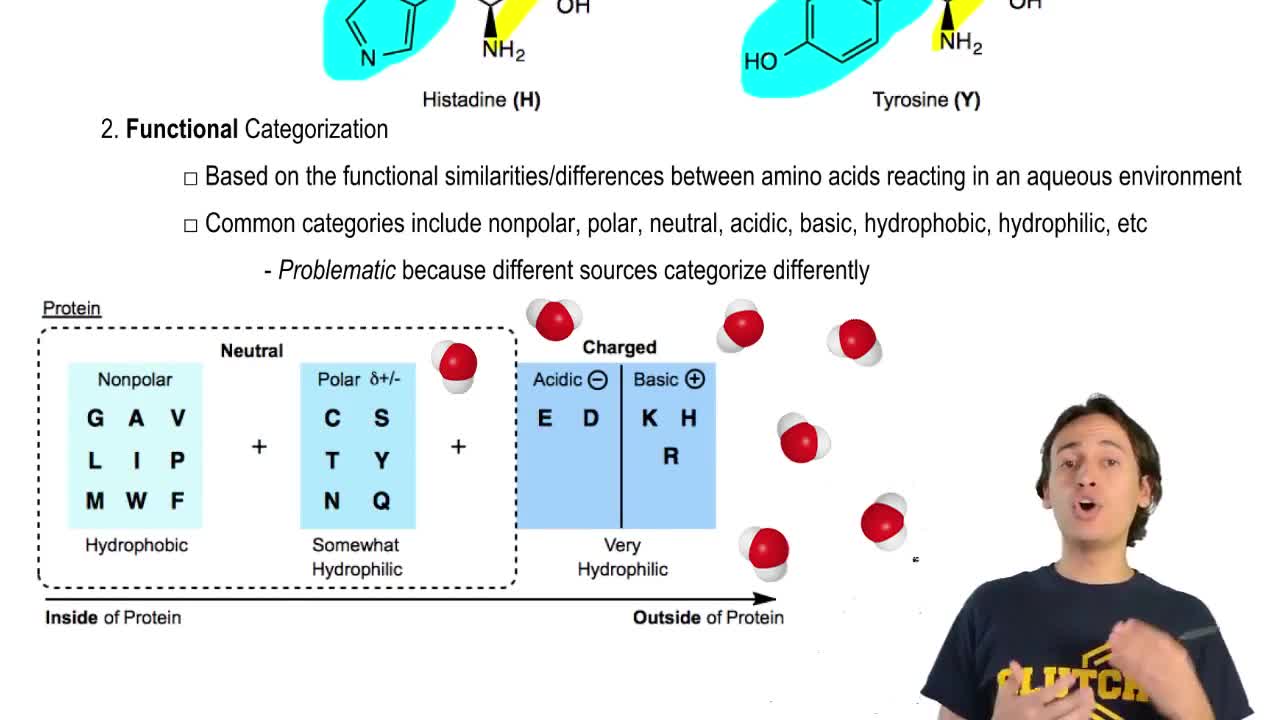
Functional Classification

Solubility Principles

Solubility is the ability of a substance to dissolve in a solvent, which is influenced by the nature of both the solute and the solvent. The principle 'like dissolves like' indicates that polar solutes are more soluble in polar solvents, while nonpolar solutes are more soluble in nonpolar solvents. Understanding these principles is crucial for predicting the solubility of different compounds.
추천 영상:
02:01
Introducing common solvents and other molecules in organic chemistry.

Hydrogen Bonding

Hydrogen bonding is a strong type of dipole-dipole interaction that occurs when hydrogen is bonded to highly electronegative atoms like oxygen, nitrogen, or fluorine. This interaction significantly increases the solubility of compounds in water, as it allows for the formation of strong attractions between the solute and solvent molecules. Compounds capable of hydrogen bonding are typically more soluble in water.
추천 영상:
00:48
The definition of hydrogenation.