Ch. 11 - Properties and Synthesis of Alkyl Halides: Radical Reactions
Mullins - Organic Chemistry: A Learner Centered Approach 1st Edition
Mullins1st EditionOrganic Chemistry: A Learner Centered ApproachISBN: 9780137566471당신이 사용하는 게 아니라요?교과서 변경
10장, 문제 30d

In the following molecules, identify the carbon where the radical is most likely to form in the first propagation step.
(d) Chemical structure of a cyclopentene ring with a methyl group attached to the allylic position.

검증된 단계별 안내
1
Identify the structure of the molecule in question. Look for any functional groups or structural features that might influence radical formation.
Consider the stability of radicals. Radicals are more stable on tertiary carbons than on secondary or primary carbons due to hyperconjugation and the inductive effect.
Examine the molecule for resonance stabilization. Radicals that can be stabilized by resonance are more likely to form. Look for allylic or benzylic positions where resonance can occur.
Assess the steric hindrance around potential radical sites. Less sterically hindered sites are more accessible for radical formation.
Evaluate the electronic effects such as inductive effects from nearby electronegative atoms or groups that might stabilize or destabilize a radical at a particular carbon.

비슷한 문제에 대한 검증된 영상 답변:

이 영상 해법은 위 문제에 도움이 된다고 튜터들이 추천한 것입니다.
영상 길이:
2m

주요 개념

질문에 올바르게 답하기 위해 반드시 이해해야 하는 핵심 개념들은 다음과 같습니다.

Radical Stability

Radical stability is crucial in determining where a radical is most likely to form. Radicals are more stable when they are tertiary, secondary, or allylic due to hyperconjugation and resonance effects. Understanding these stability factors helps predict the most favorable site for radical formation.
추천 영상:
03:43
The radical stability trend.

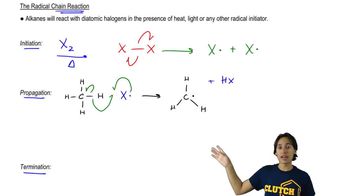
Propagation Step in Radical Reactions

The propagation step in radical reactions involves the transfer of a radical from one molecule to another, continuing the chain reaction. Identifying the carbon where the radical forms in this step requires understanding the mechanism and stability of intermediates involved in the reaction.
추천 영상:
12:11
Radical Chain Reaction Mechanism.

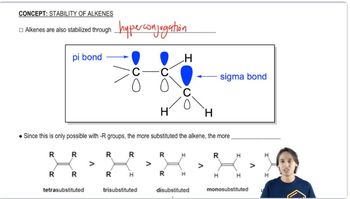
Hyperconjugation

Hyperconjugation is the delocalization of electrons in sigma bonds (C-H or C-C) that can stabilize radicals. It occurs when adjacent alkyl groups donate electron density to the radical center, enhancing stability. This concept is key in predicting radical formation sites in organic molecules.
추천 영상:
04:28
Understanding trends of alkene stability.