Ch. 11 - Properties and Synthesis of Alkyl Halides: Radical Reactions
Mullins - Organic Chemistry: A Learner Centered Approach 1st Edition
Mullins1st EditionOrganic Chemistry: A Learner Centered ApproachISBN: 9780137566471당신이 사용하는 게 아니라요?교과서 변경
10장, 문제 21

Suppose a 2-halobutane was needed for a synthetic sequence. Starting your synthesis with butane, would it be best to put a chlorine or bromine at that position? Explain.
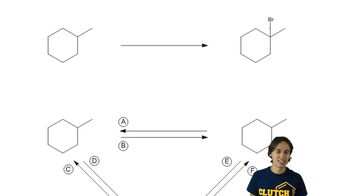
Chemical reaction showing butane converting to 2-halobutane with halogen X at the second carbon position.

검증된 단계별 안내
1
Identify the position on butane where the halogen will be added. In this case, we are looking to synthesize 2-halobutane, which means the halogen will be added to the second carbon in the butane chain.
Consider the reactivity and selectivity of halogens. Chlorine and bromine are both halogens that can be used in radical halogenation reactions, but they have different reactivity profiles. Chlorine is more reactive but less selective, while bromine is less reactive but more selective.
Evaluate the reaction conditions. Radical halogenation typically involves the use of heat or light to initiate the reaction. The choice of halogen will affect the reaction conditions needed to achieve the desired product.
Consider the selectivity of the halogenation process. Bromine, being more selective, is more likely to add to the secondary carbon (C-2) in butane, leading to a higher yield of 2-bromobutane compared to 2-chlorobutane, which might result in a mixture of products due to chlorine's lower selectivity.
Decide on the halogen based on the desired outcome. Given the need for a specific 2-halobutane, bromine would be the better choice due to its higher selectivity, which minimizes the formation of undesired isomers and maximizes the yield of the target compound.

비슷한 문제에 대한 검증된 영상 답변:

이 영상 해법은 위 문제에 도움이 된다고 튜터들이 추천한 것입니다.
영상 길이:
5m

주요 개념

질문에 올바르게 답하기 위해 반드시 이해해야 하는 핵심 개념들은 다음과 같습니다.

Halogenation of Alkanes

Halogenation is a chemical reaction that involves the addition of halogens to alkanes, typically through a free radical mechanism. In the case of butane, halogenation can introduce a chlorine or bromine atom at a specific position, such as the 2-position, by using reagents like Cl2 or Br2 under UV light or heat. The choice of halogen affects the reactivity and selectivity of the reaction.
추천 영상:
02:47
Functionalizing Alkanes

Reactivity of Halogens

Chlorine and bromine differ in their reactivity due to their atomic size and bond strength. Chlorine is more reactive than bromine, leading to faster reactions but potentially less selectivity. Bromine, being less reactive, can offer more controlled and selective halogenation, which is often preferred in synthetic sequences to minimize side reactions and improve yield.
추천 영상:
03:45
Halogenation Mechanism

Stability of Alkyl Halides

The stability of alkyl halides is influenced by the type of halogen and the position of substitution. Secondary alkyl halides, like 2-halobutane, are generally more stable than primary ones due to hyperconjugation and inductive effects. Bromine, forming weaker C-Br bonds compared to C-Cl, can result in more stable intermediates, which is advantageous in synthesis for subsequent reactions.
추천 영상:
01:52
How to name alkyl halides