Ch. 12 - Substitution and Elimination: Reactions of Haloalkanes
Mullins - Organic Chemistry: A Learner Centered Approach 1st Edition
Mullins1st EditionOrganic Chemistry: A Learner Centered ApproachISBN: 9780137566471당신이 사용하는 게 아니라요?교과서 변경
11장, 문제 80

Crown ethers are able to solvate cations based on their size. Specifically, 15-crown-5 forms stable complexes with sodium. How would the addition of a crown ether change the rate of an SN2 reaction?

검증된 단계별 안내
1
Crown ethers, such as 15-crown-5, are cyclic compounds containing multiple ether groups. These ethers can coordinate with cations, stabilizing them through electrostatic interactions.
In the provided image, 15-crown-5 forms a stable complex with sodium ions (Na⁺). This stabilization effectively separates the sodium cation from its counterion (CN⁻), increasing the availability of the nucleophile (CN⁻) in solution.
An SN2 reaction involves a nucleophile attacking an electrophilic carbon, leading to a single-step substitution mechanism. The rate of an SN2 reaction depends on the concentration and strength of the nucleophile.
By solvating the sodium ion, the crown ether reduces the ionic interaction between Na⁺ and CN⁻, thereby increasing the free concentration of CN⁻ in solution. This enhances the nucleophilicity of CN⁻, which can increase the rate of the SN2 reaction.
Thus, the addition of a crown ether like 15-crown-5 can accelerate the SN2 reaction by increasing the availability of the nucleophile through cation solvation.

비슷한 문제에 대한 검증된 영상 답변:

이 영상 해법은 위 문제에 도움이 된다고 튜터들이 추천한 것입니다.

주요 개념

질문에 올바르게 답하기 위해 반드시 이해해야 하는 핵심 개념들은 다음과 같습니다.

Crown Ethers

Crown ethers are cyclic compounds that contain multiple ether groups, which can selectively bind cations based on their size. For example, 15-crown-5 is particularly effective at complexing with sodium ions due to its cavity size, allowing it to stabilize the cation in solution. This property is crucial in influencing reaction rates in organic chemistry, especially in nucleophilic substitution reactions.
추천 영상:
04:22
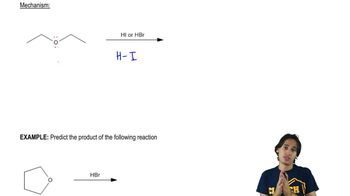
How to predict the products of Ether Cleavage.

S<sub>N</sub>2 Reaction Mechanism

The S<sub>N</sub>2 reaction mechanism is a type of nucleophilic substitution where a nucleophile attacks an electrophile, resulting in the simultaneous displacement of a leaving group. This bimolecular process is characterized by a single transition state and is influenced by sterics and the nature of the solvent. The presence of crown ethers can enhance the rate of S<sub>N</sub>2 reactions by solubilizing cations and reducing the activation energy required for the nucleophile to approach the electrophile.
추천 영상:
02:16
Heck Reaction Mechanism

Solvation and Reaction Rates

Solvation refers to the interaction between solvent molecules and solute ions or molecules, which can significantly affect reaction rates. In the context of S<sub>N</sub>2 reactions, effective solvation of cations by crown ethers can stabilize the transition state and lower the energy barrier for the reaction. This leads to an increased rate of reaction, as the nucleophile can more easily access the electrophile when the cation is effectively solvated.
추천 영상:
가이드 코스
5:07
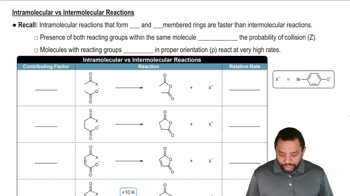
Rates of Intramolecular Reactions Concept 2