Ch. 12 - Substitution and Elimination: Reactions of Haloalkanes
Mullins - Organic Chemistry: A Learner Centered Approach 1st Edition
Mullins1st EditionOrganic Chemistry: A Learner Centered ApproachISBN: 9780137566471당신이 사용하는 게 아니라요?교과서 변경
11장, 문제 57d

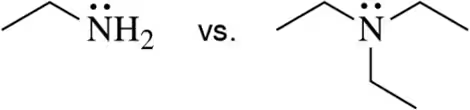
For each pair, choose the nucleophile that would react most quickly in an SN2 reaction (assume H2O is the solvent).
(d) Comparison of two nucleophiles: amine group structure on the left and a nitrogen atom structure on the right.

검증된 단계별 안내
1
Understand the Sₙ2 reaction mechanism: The Sₙ2 reaction is a bimolecular nucleophilic substitution reaction where the nucleophile attacks the electrophilic carbon in a single concerted step, displacing the leaving group. The rate of the reaction depends on the strength of the nucleophile and the steric hindrance around the electrophilic carbon.
Identify the nucleophiles in the given pair. Compare their structures and consider factors such as charge, electronegativity, and polarizability. Stronger nucleophiles are typically negatively charged species or less electronegative atoms that can donate electrons more readily.
Consider the solvent effect: Since the solvent is H₂O (a polar protic solvent), it can stabilize charged species through hydrogen bonding. In polar protic solvents, larger, more polarizable nucleophiles tend to be stronger because they are less solvated and can attack the electrophile more effectively.
Compare the nucleophiles based on their periodic trends: In polar protic solvents, nucleophilicity increases down a group in the periodic table due to increased polarizability. For example, iodide (I⁻) is a stronger nucleophile than fluoride (F⁻) in such solvents.
Choose the nucleophile that would react most quickly in the Sₙ2 reaction based on the above considerations. The nucleophile with higher nucleophilicity in the given solvent will react faster in the Sₙ2 mechanism.

비슷한 문제에 대한 검증된 영상 답변:

이 영상 해법은 위 문제에 도움이 된다고 튜터들이 추천한 것입니다.
영상 길이:
2m

주요 개념

질문에 올바르게 답하기 위해 반드시 이해해야 하는 핵심 개념들은 다음과 같습니다.

Nucleophilicity

Nucleophilicity refers to the ability of a species to donate an electron pair to an electrophile, forming a chemical bond. In Sₙ2 reactions, stronger nucleophiles react more quickly because they can more effectively attack the electrophilic carbon. Factors influencing nucleophilicity include charge, electronegativity, and solvent effects, with negatively charged species generally being more nucleophilic than their neutral counterparts.
추천 영상:
08:27
Nucleophilic Addition

Sₙ2 Mechanism

The Sₙ2 (substitution nucleophilic bimolecular) mechanism involves a single concerted step where the nucleophile attacks the electrophile while the leaving group departs. This reaction is characterized by a backside attack, leading to inversion of configuration at the carbon center. The rate of an Sₙ2 reaction depends on both the concentration of the nucleophile and the electrophile, making it bimolecular.
추천 영상:
04:32
General Mechanism

Solvent Effects

The choice of solvent can significantly influence the rate of Sₙ2 reactions. Polar protic solvents, like water, can stabilize ions and slow down the reaction by solvation of the nucleophile, while polar aprotic solvents enhance nucleophilicity by not solvate the nucleophile as effectively. Understanding how solvent properties affect nucleophilicity is crucial for predicting reaction outcomes in Sₙ2 mechanisms.
추천 영상:
01:16
Identification of polarity in solvents