Ch. 12 - Substitution and Elimination: Reactions of Haloalkanes
Mullins - Organic Chemistry: A Learner Centered Approach 1st Edition
Mullins1st EditionOrganic Chemistry: A Learner Centered ApproachISBN: 9780137566471당신이 사용하는 게 아니라요?교과서 변경
11장, 문제 41b

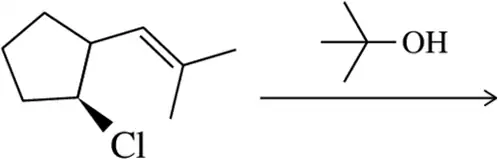
Given the reactants shown, what type of elimination would you expect to occur?
(b) Chemical structures of a chlorine-substituted cyclohexene and an alcohol, indicating a reaction pathway.

검증된 단계별 안내
1
Step 1: Analyze the structure of the reactants. The molecule on the left contains a cyclopentane ring with a chlorine atom attached to a carbon that is adjacent to a double bond. This is a secondary alkyl halide. The molecule on the right is tert-butanol, which is a bulky alcohol.
Step 2: Consider the reaction conditions. Tert-butanol is often used in elimination reactions, and its bulky nature suggests that steric hindrance will favor elimination over substitution. Additionally, the presence of a strong base (likely the alkoxide form of tert-butanol) will promote elimination.
Step 3: Determine the type of elimination mechanism. The bulky base and the secondary alkyl halide suggest that the reaction will proceed via an E2 mechanism. In an E2 reaction, the base abstracts a proton from a β-carbon, and the leaving group (chlorine) departs simultaneously, forming a double bond.
Step 4: Examine the stereochemistry of the elimination. For an E2 reaction, the β-hydrogen and the leaving group must be anti-periplanar (i.e., opposite and in the same plane). In this case, the chlorine atom and the β-hydrogen are positioned appropriately for anti-periplanar elimination.
Step 5: Predict the product. The elimination will result in the formation of a conjugated diene, as the double bond already present in the molecule will extend conjugation with the newly formed double bond. This increases the stability of the product.

비슷한 문제에 대한 검증된 영상 답변:

이 영상 해법은 위 문제에 도움이 된다고 튜터들이 추천한 것입니다.

주요 개념

질문에 올바르게 답하기 위해 반드시 이해해야 하는 핵심 개념들은 다음과 같습니다.

Elimination Reactions

Elimination reactions involve the removal of atoms or groups from a molecule, resulting in the formation of a double bond or a ring structure. In organic chemistry, these reactions are typically classified as either E1 or E2 mechanisms, depending on the reaction conditions and the nature of the substrate. Understanding the type of elimination is crucial for predicting the products formed during the reaction.
추천 영상:
00:40
Recognizing Elimination Reactions.

E2 Mechanism

The E2 mechanism is a concerted elimination process where a base abstracts a proton while a leaving group departs simultaneously, leading to the formation of a double bond. This mechanism is favored in strong bases and requires a specific geometric arrangement of the substrate, often involving anti-periplanar orientation of the leaving group and the hydrogen being removed. Recognizing the conditions that favor E2 is essential for predicting the outcome of the reaction.
추천 영상:
09:36
Drawing the E2 Mechanism.

Substituent Effects

The presence of substituents on a cyclohexene can significantly influence the type of elimination reaction that occurs. For instance, bulky groups can hinder certain pathways, while electron-withdrawing or donating groups can stabilize transition states or intermediates. Understanding how these substituents affect reactivity and selectivity is vital for predicting the products of elimination reactions.
추천 영상:
가이드 코스
2:02
Directing Effects in Substituted Pyrroles, Furans, and Thiophenes Concept 1