Ch. 12 - Substitution and Elimination: Reactions of Haloalkanes
Mullins - Organic Chemistry: A Learner Centered Approach 1st Edition
Mullins1st EditionOrganic Chemistry: A Learner Centered ApproachISBN: 9780137566471당신이 사용하는 게 아니라요?교과서 변경
11장, 문제 7c

In the following reactions, identify the bonds formed and the bonds broken.
(c) Chemical reaction showing the formation of an alcohol and bromide from an alkene and alcohol, with bonds broken and formed.

검증된 단계별 안내
1
Analyze the reactants: The reaction involves ethanol (CH3CH2OH) and a tertiary alkyl bromide (CH3C(Br)(Ph)CH3). Ethanol acts as a nucleophile, and the tertiary alkyl bromide undergoes a substitution reaction.
Identify the bonds broken: The C-Br bond in the tertiary alkyl bromide is broken during the reaction, resulting in the formation of a carbocation intermediate. Additionally, the O-H bond in ethanol is broken as the oxygen donates a lone pair to form a bond with the carbocation.
Identify the bonds formed: A new C-O bond is formed between the carbocation (CH3C(+)(Ph)CH3) and the oxygen atom of ethanol. Additionally, a Br⁻ ion is released as a result of the C-Br bond cleavage.
Examine the products: The reaction produces a protonated ether (CH3CH2O⁺H), a bromide ion (Br⁻), and an alkene (CH2=C(Ph)CH3). The alkene forms due to elimination of a proton from the carbocation intermediate.
Summarize the reaction mechanism: This reaction proceeds via an SN1 mechanism, where the tertiary alkyl bromide first forms a carbocation intermediate. Ethanol acts as a nucleophile, attacking the carbocation to form the ether. Simultaneously, elimination occurs to produce the alkene.

비슷한 문제에 대한 검증된 영상 답변:

이 영상 해법은 위 문제에 도움이 된다고 튜터들이 추천한 것입니다.

주요 개념

질문에 올바르게 답하기 위해 반드시 이해해야 하는 핵심 개념들은 다음과 같습니다.

Nucleophilic Substitution

Nucleophilic substitution is a fundamental reaction in organic chemistry where a nucleophile attacks an electrophile, resulting in the replacement of a leaving group. In this reaction, the hydroxide ion (OH-) acts as a nucleophile, attacking the carbon atom bonded to bromine (Br), which is the leaving group. Understanding this concept is crucial for identifying which bonds are broken and formed during the reaction.
추천 영상:
01:47
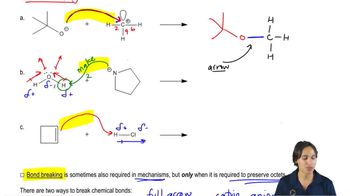
Nucleophiles and Electrophiles can react in Substitution Reactions.

Bond Formation and Breaking

In chemical reactions, bonds are both formed and broken. In the given reaction, the C-Br bond is broken as bromine leaves, while a new C-O bond is formed when the hydroxide ion attaches to the carbon atom. Recognizing which specific bonds are involved helps in predicting the products and understanding the mechanism of the reaction.
추천 영상:
02:31
Identifying Bond Breaking

Reaction Mechanism

A reaction mechanism describes the step-by-step process by which reactants are converted into products. It includes details about the intermediates formed and the transition states. In this case, the mechanism involves the nucleophilic attack of the hydroxide ion on the carbon atom, leading to the formation of an alkoxide intermediate before the final products are generated. Understanding the mechanism is essential for grasping the overall reaction dynamics.
추천 영상:
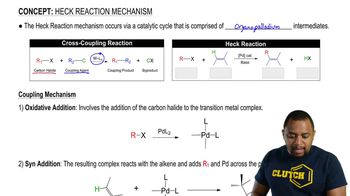
02:16
Heck Reaction Mechanism