Ch. 12 - Substitution and Elimination: Reactions of Haloalkanes
Mullins - Organic Chemistry: A Learner Centered Approach 1st Edition
Mullins1st EditionOrganic Chemistry: A Learner Centered ApproachISBN: 9780137566471당신이 사용하는 게 아니라요?교과서 변경
11장, 문제 11c

Practice your electron-pushing skills by drawing a mechanism for the following SN2 reactions.
(c) Chemical reaction diagram illustrating an SN2 reaction with sodium azide in THF, showing reactants and products.

검증된 단계별 안내
1
Step 1: Identify the type of reaction. This is an SN2 reaction, which is a bimolecular nucleophilic substitution. In SN2 reactions, the nucleophile attacks the electrophilic carbon directly, displacing the leaving group in a single concerted step.
Step 2: Analyze the reactants. The substrate is a secondary alkyl iodide, and the nucleophile is azide (N₃⁻), provided by Na⁺N₃ in the solvent tetrahydrofuran (THF). Iodine (I⁻) is the leaving group.
Step 3: Determine the stereochemistry. SN2 reactions proceed with inversion of configuration at the electrophilic carbon due to the backside attack of the nucleophile. The wedge bond in the product indicates that the stereochemistry has been inverted compared to the reactant.
Step 4: Draw the electron-pushing mechanism. The azide ion (N₃⁻) attacks the electrophilic carbon from the opposite side of the iodine atom. Use curved arrows to show the movement of electrons: one arrow from the lone pair on N₃⁻ to the electrophilic carbon, and another arrow from the C-I bond to the iodine atom, forming I⁻.
Step 5: Confirm the products. The reaction produces the inverted alkyl azide and iodide ion (I⁻) as the leaving group. Ensure the stereochemistry of the product matches the inversion expected in SN2 reactions.

비슷한 문제에 대한 검증된 영상 답변:

이 영상 해법은 위 문제에 도움이 된다고 튜터들이 추천한 것입니다.
영상 길이:
2m

주요 개념

질문에 올바르게 답하기 위해 반드시 이해해야 하는 핵심 개념들은 다음과 같습니다.

S<sub>N</sub>2 Mechanism

The S<sub>N</sub>2 mechanism is a type of nucleophilic substitution reaction where a nucleophile attacks an electrophile, resulting in the simultaneous displacement of a leaving group. This reaction occurs in a single concerted step, leading to the inversion of configuration at the carbon center. Understanding this mechanism is crucial for predicting the outcome of reactions involving primary and secondary alkyl halides.
추천 영상:
05:29
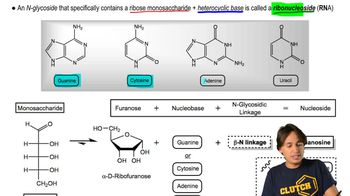
Creating Ribonucleosides

Nucleophiles and Electrophiles

Nucleophiles are species that donate an electron pair to form a chemical bond, while electrophiles are electron-deficient species that accept electron pairs. In the context of the S<sub>N</sub>2 reaction, the nucleophile (in this case, azide ion, N<sub>3</sub><sup>-</sup>) attacks the electrophilic carbon bonded to the leaving group (iodide, I<sup>-</sup>). Recognizing these roles is essential for understanding reaction mechanisms.
추천 영상:
03:
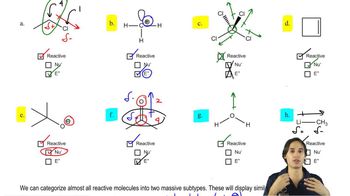
Nucleophile or Electrophile

Leaving Groups

A leaving group is an atom or group that can depart with a pair of electrons in a nucleophilic substitution reaction. Good leaving groups are typically weak bases, such as halides (e.g., I<sup>-</sup>), which stabilize the negative charge after leaving. The ability of a leaving group to depart easily influences the rate and feasibility of the S<sub>N</sub>2 reaction, making it a key concept in organic chemistry.
추천 영상:
07:22
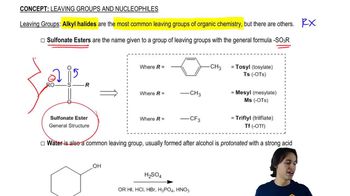
The 3 important leaving groups to know.