Ch. 12 - Substitution and Elimination: Reactions of Haloalkanes
Mullins - Organic Chemistry: A Learner Centered Approach 1st Edition
Mullins1st EditionOrganic Chemistry: A Learner Centered ApproachISBN: 9780137566471당신이 사용하는 게 아니라요?교과서 변경
11장, 문제 31b

Predict the product of the substitution reactions, paying attention to the stereochemical outcome.
(b)

검증된 단계별 안내
1
Analyze the structure of the starting material: The molecule contains a bromine atom attached to a chiral carbon, which is bonded to a thiophene ring and two alkyl groups. The bromine is in the wedge position, indicating its stereochemistry.
Identify the reagent and solvent: KSCN (potassium thiocyanate) is a nucleophile, and THF (tetrahydrofuran) is a polar aprotic solvent. Polar aprotic solvents favor SN2 reactions, where the nucleophile attacks the electrophilic carbon directly.
Determine the reaction mechanism: Since the solvent is polar aprotic and the substrate is a secondary alkyl halide, the reaction is likely to proceed via an SN2 mechanism. In an SN2 reaction, the nucleophile (SCN⁻) will attack the carbon bonded to bromine, leading to the inversion of stereochemistry at the chiral center.
Predict the product: The bromine atom will be replaced by the thiocyanate group (SCN). Due to the SN2 mechanism, the stereochemistry of the chiral center will invert, meaning the SCN group will occupy the opposite stereochemical position (dash instead of wedge).
Verify the stereochemical outcome: The final product will have the SCN group in the dash position, opposite to the original bromine atom's wedge position, ensuring stereochemical inversion as expected in an SN2 reaction.

비슷한 문제에 대한 검증된 영상 답변:

이 영상 해법은 위 문제에 도움이 된다고 튜터들이 추천한 것입니다.

주요 개념

질문에 올바르게 답하기 위해 반드시 이해해야 하는 핵심 개념들은 다음과 같습니다.

Nucleophilic Substitution Reactions

Nucleophilic substitution reactions involve the replacement of a leaving group in a molecule by a nucleophile. These reactions can occur via two main mechanisms: SN1 and SN2. The SN1 mechanism is a two-step process where the leaving group departs first, forming a carbocation, while the SN2 mechanism is a one-step process where the nucleophile attacks the substrate simultaneously as the leaving group departs.
추천 영상:
01:47
Nucleophiles and Electrophiles can react in Substitution Reactions.

Stereochemistry

Stereochemistry refers to the study of the spatial arrangement of atoms in molecules and how this affects their chemical behavior. In substitution reactions, the stereochemical outcome is crucial, as it determines whether the product retains or inverts the configuration at the chiral center. Understanding stereochemistry is essential for predicting the specific isomer formed in a reaction.
추천 영상:
가이드 코스
1:38
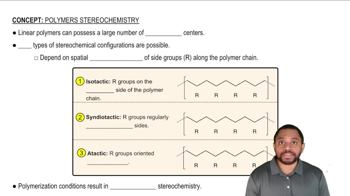
Polymer Stereochemistry Concept 1

Leaving Groups

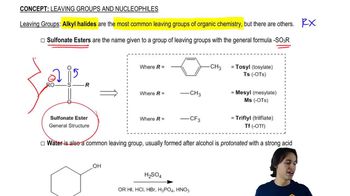
Leaving groups are atoms or groups that can depart from the parent molecule during a chemical reaction, facilitating nucleophilic substitution. A good leaving group is typically stable after departure, such as halides or sulfonate groups. The nature of the leaving group significantly influences the reaction rate and mechanism, making it a key factor in predicting the products of substitution reactions.
추천 영상:
07:22
The 3 important leaving groups to know.