Ch. 12 - Substitution and Elimination: Reactions of Haloalkanes
Mullins - Organic Chemistry: A Learner Centered Approach 1st Edition
Mullins1st EditionOrganic Chemistry: A Learner Centered ApproachISBN: 9780137566471당신이 사용하는 게 아니라요?교과서 변경
11장, 문제 53d

Suggest a mechanism for the following elimination reactions.
(d)

검증된 단계별 안내
1
Step 1: Identify the type of elimination reaction. This reaction involves the removal of a hydrogen atom and a leaving group (Cl) to form a double bond. The presence of ethanol (EtOH) suggests that this is likely an E1 elimination mechanism, as ethanol is a polar protic solvent that stabilizes carbocations.
Step 2: Formation of the carbocation intermediate. The chlorine atom acts as the leaving group, departing from the molecule and generating a carbocation at the benzylic position. This step is facilitated by the stability of the benzylic carbocation due to resonance stabilization.
Step 3: Analyze the carbocation stability. The benzylic carbocation formed is highly stabilized by resonance with the aromatic ring, which makes the E1 mechanism favorable.
Step 4: Proton abstraction to form the double bond. A base (ethanol or a trace amount of hydroxide ion) abstracts a proton from the β-carbon adjacent to the carbocation. This leads to the formation of a double bond, resulting in the final product.
Step 5: Confirm the product structure. The elimination reaction results in the formation of a conjugated diene system, which is stabilized by resonance. The final product is a bicyclic compound with two aromatic rings connected by a double bond.

비슷한 문제에 대한 검증된 영상 답변:

이 영상 해법은 위 문제에 도움이 된다고 튜터들이 추천한 것입니다.
영상 길이:
2m

주요 개념

질문에 올바르게 답하기 위해 반드시 이해해야 하는 핵심 개념들은 다음과 같습니다.

Elimination Reactions

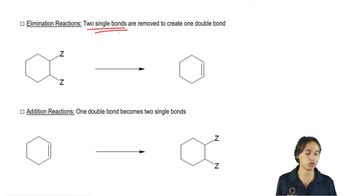
Elimination reactions involve the removal of a small molecule from a larger one, typically resulting in the formation of a double bond. In organic chemistry, common types include E1 and E2 mechanisms, which differ in their steps and conditions. Understanding the type of elimination is crucial for predicting the products and the mechanism involved.
추천 영상:
00:40
Recognizing Elimination Reactions.

Mechanism of E2 Reactions

The E2 mechanism is a concerted process where the base abstracts a proton while the leaving group departs, leading to the formation of a double bond. This mechanism requires a strong base and typically occurs in a single step. The stereochemistry of the substrate can influence the outcome, making it essential to consider the spatial arrangement of atoms.
추천 영상:
09:36
Drawing the E2 Mechanism.

Role of Solvents in Reactions

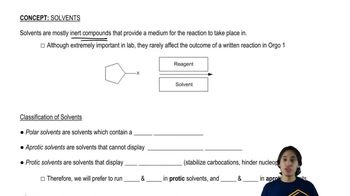
The choice of solvent can significantly affect the rate and outcome of organic reactions. In this case, ethanol (EtOH) serves as a polar protic solvent, which can stabilize ions and facilitate the elimination process. Understanding solvent effects is vital for optimizing reaction conditions and predicting product formation.
추천 영상:
02:26
General format of reactions and how to interpret solvents.