Ch. 12 - Substitution and Elimination: Reactions of Haloalkanes
Mullins - Organic Chemistry: A Learner Centered Approach 1st Edition
Mullins1st EditionOrganic Chemistry: A Learner Centered ApproachISBN: 9780137566471당신이 사용하는 게 아니라요?교과서 변경
11장, 문제 25a

Which of the following is the better leaving group in a polar aprotic solvent?
(a) HO⁻ vs. F⁻

검증된 단계별 안내
1
Understand the concept of leaving groups: A leaving group is an atom or group of atoms that can depart with a pair of electrons during a chemical reaction. A better leaving group is typically more stable after leaving, often due to its ability to stabilize the negative charge.
Recall the effect of the solvent: In a polar aprotic solvent, the solvent does not donate hydrogen bonds to stabilize ions. This means that the leaving group's stability depends more on its intrinsic properties rather than solvent interactions.
Compare the basicity of the leaving groups: Basicity is inversely related to leaving group ability. A weaker base is a better leaving group because it is more stable after leaving. Hydroxide ion (HO⁻) is a stronger base than fluoride ion (F⁻), as oxygen is less electronegative than fluorine.
Consider the electronegativity of the atoms: Fluorine is more electronegative than oxygen, meaning it can better stabilize the negative charge when it becomes F⁻. This makes F⁻ a better leaving group than HO⁻ in general.
Conclude based on the solvent and properties: In a polar aprotic solvent, F⁻ is the better leaving group compared to HO⁻ because it is less basic and more stable as an ion due to its high electronegativity.

비슷한 문제에 대한 검증된 영상 답변:

이 영상 해법은 위 문제에 도움이 된다고 튜터들이 추천한 것입니다.
영상 길이:
1m

주요 개념

질문에 올바르게 답하기 위해 반드시 이해해야 하는 핵심 개념들은 다음과 같습니다.

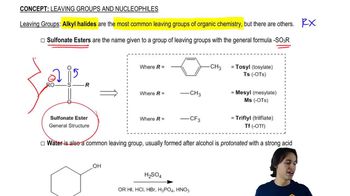
Leaving Groups

Leaving groups are atoms or groups of atoms that can depart from a molecule during a chemical reaction, taking with them the electrons that were shared with the molecule. A good leaving group is typically stable after departure, which allows for smoother reaction pathways. Common examples include halides and water, while poor leaving groups include hydroxide (OH⁻) and fluoride (F⁻).
추천 영상:
07:22
The 3 important leaving groups to know.

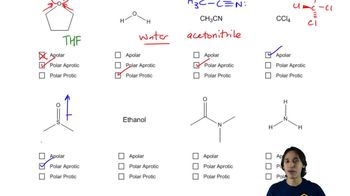
Polar Aprotic Solvents

Polar aprotic solvents are solvents that have a significant dipole moment but do not have hydrogen atoms bonded to electronegative atoms, which means they cannot form hydrogen bonds. These solvents can stabilize cations and polarize anions, enhancing the reactivity of nucleophiles. Examples include acetone and dimethyl sulfoxide (DMSO), which are often used in reactions involving strong nucleophiles.
추천 영상:
00:37
Identification of polarity in solvents

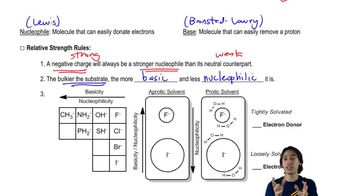
Nucleophilicity and Basicity

Nucleophilicity refers to the ability of a species to donate an electron pair to an electrophile, while basicity measures the tendency of a species to accept protons. In polar aprotic solvents, nucleophilicity is often enhanced for anions because these solvents do not solvate anions as effectively as protic solvents. This distinction is crucial when comparing the leaving groups HO⁻ and F⁻, as their stability and reactivity can vary significantly in different solvent environments.
추천 영상:
06:21
Understanding the difference between basicity and nucleophilicity.