Ch. 12 - Substitution and Elimination: Reactions of Haloalkanes
Mullins - Organic Chemistry: A Learner Centered Approach 1st Edition
Mullins1st EditionOrganic Chemistry: A Learner Centered ApproachISBN: 9780137566471당신이 사용하는 게 아니라요?교과서 변경
11장, 문제 14

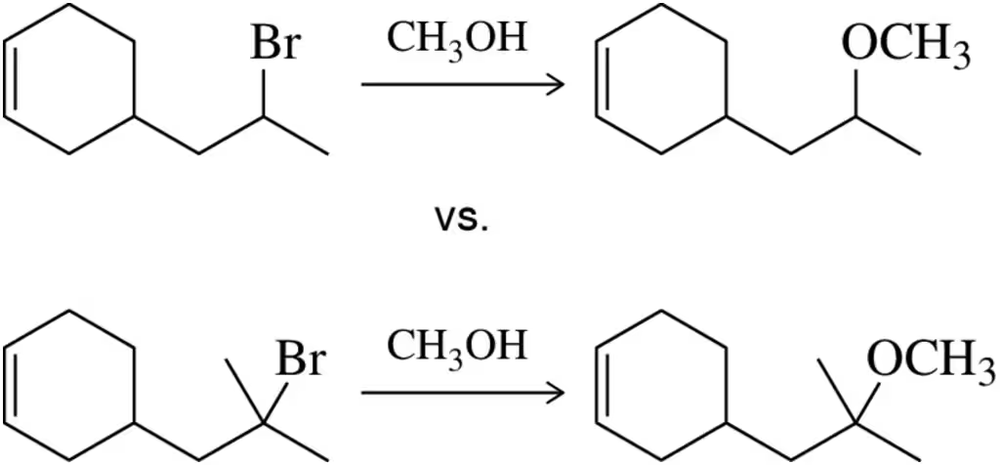
Which of the following SN1 reactions should proceed at a faster rate? Justify your answer on a reaction coordinate diagram.
Comparison of two SN1 reactions with bromine and methanol, showing different reaction pathways and products.

검증된 단계별 안내
1
Step 1: Understand the Sₙ1 reaction mechanism. The Sₙ1 reaction is a two-step process where the rate-determining step is the formation of a carbocation intermediate. The rate of the reaction depends on the stability of this carbocation intermediate.
Step 2: Analyze the substrates provided in the problem. Identify the leaving group and the carbon atom where the carbocation will form after the leaving group departs. Consider the electronic environment around this carbon atom.
Step 3: Evaluate the stability of the carbocation intermediates. Carbocation stability increases in the following order: methyl < primary < secondary < tertiary < allylic < benzylic. Additionally, resonance and hyperconjugation effects can further stabilize the carbocation.
Step 4: Use a reaction coordinate diagram to justify your answer. On the diagram, the y-axis represents the energy, and the x-axis represents the reaction progress. The energy of the transition state and the intermediate carbocation will be lower for the substrate that forms the more stable carbocation, leading to a faster reaction rate.
Step 5: Compare the two substrates based on the above analysis. The substrate that forms the more stable carbocation will have a lower activation energy (smaller energy barrier) and will proceed at a faster rate in the Sₙ1 reaction.

비슷한 문제에 대한 검증된 영상 답변:

이 영상 해법은 위 문제에 도움이 된다고 튜터들이 추천한 것입니다.
영상 길이:
11m

주요 개념

질문에 올바르게 답하기 위해 반드시 이해해야 하는 핵심 개념들은 다음과 같습니다.

Sₙ1 Mechanism

The Sₙ1 (substitution nucleophilic unimolecular) mechanism involves a two-step process where the rate-determining step is the formation of a carbocation intermediate. This mechanism is favored in polar protic solvents and typically occurs with tertiary substrates due to their ability to stabilize the carbocation. Understanding the Sₙ1 mechanism is crucial for predicting reaction rates and outcomes.
추천 영상:
04:32
General Mechanism

Carbocation Stability

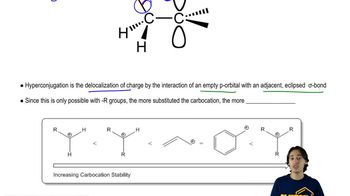
Carbocation stability is a key factor in Sₙ1 reactions, as more stable carbocations form more readily and lead to faster reaction rates. Stability is influenced by factors such as the degree of substitution (tertiary > secondary > primary) and resonance effects. Recognizing the stability of the carbocation formed in a given reaction helps in determining which reaction will proceed faster.
추천 영상:
05:58
Determining Carbocation Stability

Reaction Coordinate Diagram

A reaction coordinate diagram visually represents the energy changes during a chemical reaction. It illustrates the energy of reactants, products, and intermediates, highlighting the transition states and activation energies. By analyzing these diagrams, one can compare the energy profiles of different reactions, aiding in the justification of which Sₙ1 reaction proceeds at a faster rate.
추천 영상:
05:02
Coordination Complexes