Ch. 12 - Substitution and Elimination: Reactions of Haloalkanes
Mullins - Organic Chemistry: A Learner Centered Approach 1st Edition
Mullins1st EditionOrganic Chemistry: A Learner Centered ApproachISBN: 9780137566471당신이 사용하는 게 아니라요?교과서 변경
11장, 문제 20e

Would the following nucleophiles be more likely to participate in an SN1 or SN2 reaction?
(e) H2O

검증된 단계별 안내
1
Step 1: Understand the difference between SN1 and SN2 reactions. SN1 reactions are unimolecular nucleophilic substitution reactions that proceed through a carbocation intermediate, while SN2 reactions are bimolecular nucleophilic substitution reactions that occur in a single concerted step with a backside attack.
Step 2: Analyze the nucleophile, H₂O. Water (H₂O) is a weak nucleophile because it is neutral and does not have a strong negative charge to readily donate electrons. This makes it less effective in participating in SN2 reactions, which require strong nucleophiles.
Step 3: Consider the solvent effect. H₂O is also a polar protic solvent, which stabilizes carbocations and anions through hydrogen bonding. This stabilization favors the formation of a carbocation intermediate, making it more likely to participate in an SN1 reaction.
Step 4: Evaluate steric hindrance. Since H₂O is a small molecule, steric hindrance is not a significant factor. However, the weak nucleophilicity of H₂O still makes it more suited for SN1 reactions, where the rate-determining step does not depend on the nucleophile.
Step 5: Conclude that H₂O is more likely to participate in an SN1 reaction due to its weak nucleophilicity and its role as a polar protic solvent, which stabilizes the carbocation intermediate required for SN1 mechanisms.

비슷한 문제에 대한 검증된 영상 답변:

이 영상 해법은 위 문제에 도움이 된다고 튜터들이 추천한 것입니다.

주요 개념

질문에 올바르게 답하기 위해 반드시 이해해야 하는 핵심 개념들은 다음과 같습니다.

Nucleophiles

Nucleophiles are species that donate an electron pair to form a chemical bond in a reaction. They are typically negatively charged or neutral molecules with lone pairs of electrons. The strength and reactivity of a nucleophile can influence whether a reaction proceeds via an S_N1 or S_N2 mechanism.
추천 영상:
08:27
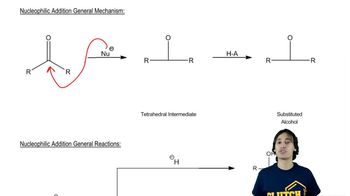
Nucleophilic Addition

S_N1 and S_N2 Mechanisms

S_N1 (unimolecular nucleophilic substitution) and S_N2 (bimolecular nucleophilic substitution) are two fundamental mechanisms of nucleophilic substitution reactions. S_N1 involves a two-step process where the leaving group departs first, forming a carbocation, followed by nucleophilic attack. In contrast, S_N2 is a one-step process where the nucleophile attacks the substrate simultaneously as the leaving group departs.
추천 영상:
04:32
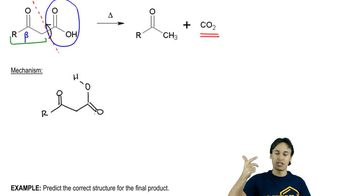
General Mechanism

Carbocation Stability

Carbocation stability is crucial in determining the likelihood of an S_N1 reaction. More stable carbocations, such as tertiary carbocations, are favored in S_N1 mechanisms due to their lower energy and greater ability to stabilize the positive charge. Conversely, S_N2 reactions are favored by less sterically hindered substrates, as they require a direct attack by the nucleophile.
추천 영상:
05:58
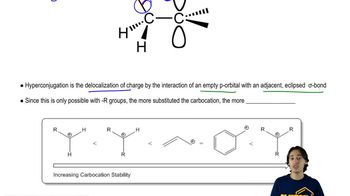
Determining Carbocation Stability