Ch. 13 - Alcohols, Ethers and Related Compounds: Substitution and Elimination
Mullins - Organic Chemistry: A Learner Centered Approach 1st Edition
Mullins1st EditionOrganic Chemistry: A Learner Centered ApproachISBN: 9780137566471당신이 사용하는 게 아니라요?교과서 변경
12장, 문제 36

Besides PBr3. and SOCl2 , there are other ways of synthesizing haloalkanes. One such way is shown. Provide an arrow-pushing mechanism that rationalizes formation of the chloroalkane. [Hint: Dimethyl sulfide is a good nucleophile and Cl₂ is an electrophile. Start by reacting those two together.]
Arrow-pushing mechanism illustrating the conversion of an alcohol to a chloroalkane using dimethyl sulfide and chlorine.

검증된 단계별 안내
1
Begin by recognizing that dimethyl sulfide ((CH₃)₂S) acts as a nucleophile and chlorine (Cl₂) as an electrophile. The sulfur atom in dimethyl sulfide has a lone pair of electrons that can attack one of the chlorine atoms in Cl₂, forming a chlorosulfonium ion ((CH₃)₂SCl⁺) and a chloride ion (Cl⁻).
Next, consider the alcohol substrate, PhCH₂CH₂OH. The hydroxyl group (OH) is a poor leaving group, but it can be converted into a better leaving group by reacting with the chlorosulfonium ion. The lone pair on the oxygen of the alcohol attacks the sulfur atom in the chlorosulfonium ion, forming an intermediate where the oxygen is bonded to the sulfur.
This intermediate is unstable and will undergo a rearrangement. The chloride ion (Cl⁻) generated in the first step can now attack the carbon atom bonded to the oxygen, leading to the displacement of the dimethyl sulfoxide group ((CH₃)₂SO) and formation of the chloroalkane (PhCH₂CH₂Cl).
The dimethyl sulfoxide ((CH₃)₂SO) is formed as a byproduct, along with hydrochloric acid (HCl) from the protonation of the chloride ion by the hydrogen from the alcohol group.
Finally, ensure that all charges are balanced and the mechanism is consistent with the formation of the products shown in the image. The arrow-pushing should reflect the movement of electrons from nucleophiles to electrophiles, resulting in the formation of the chloroalkane and the byproducts.

비슷한 문제에 대한 검증된 영상 답변:

이 영상 해법은 위 문제에 도움이 된다고 튜터들이 추천한 것입니다.

주요 개념

질문에 올바르게 답하기 위해 반드시 이해해야 하는 핵심 개념들은 다음과 같습니다.

Nucleophiles and Electrophiles

Nucleophiles are species that donate an electron pair to form a chemical bond, while electrophiles are electron-deficient species that accept an electron pair. In this reaction, dimethyl sulfide acts as a nucleophile, attacking the electrophilic chlorine molecule (Cl₂) to facilitate the substitution reaction that converts the alcohol to a chloroalkane.
추천 영상:
03:
Nucleophile or Electrophile

Arrow-Pushing Mechanism

The arrow-pushing mechanism is a way to illustrate the movement of electrons during a chemical reaction. It shows how nucleophiles attack electrophiles and how bonds are formed or broken. In this case, arrows will depict the transfer of electrons from the nucleophile (dimethyl sulfide) to the electrophile (chlorine), leading to the formation of the chloroalkane.
추천 영상:
04:32
General Mechanism

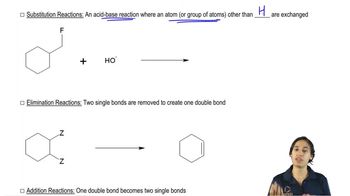
Substitution Reactions

Substitution reactions involve the replacement of one functional group in a molecule with another. In this scenario, the hydroxyl group (-OH) of the alcohol is replaced by a chlorine atom, resulting in the formation of a chloroalkane. Understanding the mechanism of substitution is crucial for predicting the products of reactions involving haloalkanes.
추천 영상:
01:34
Recognizing Substitution Reactions.