Ch. 13 - Alcohols, Ethers and Related Compounds: Substitution and Elimination
Mullins - Organic Chemistry: A Learner Centered Approach 1st Edition
Mullins1st EditionOrganic Chemistry: A Learner Centered ApproachISBN: 9780137566471당신이 사용하는 게 아니라요?교과서 변경
12장, 문제 46c

Predict the product of the following pinacol rearrangements.
(c) Chemical structure showing a cyclic compound with two hydroxyl groups, with sulfuric acid and heat indicated for a dehydration reaction.

검증된 단계별 안내
1
Step 1: Recognize that the reaction involves a pinacol rearrangement, which typically occurs under acidic conditions (H2SO4) and heat (Δ). This rearrangement converts a vicinal diol into a ketone or aldehyde through a carbocation intermediate.
Step 2: Protonate one of the hydroxyl groups using H2SO4 to form a good leaving group (water). This step increases the electrophilicity of the carbon attached to the protonated hydroxyl group.
Step 3: Eliminate the water molecule to generate a carbocation intermediate. The carbocation will form at the carbon that was initially bonded to the protonated hydroxyl group.
Step 4: Perform a 1,2-methyl shift (or hydride shift, depending on the structure) to stabilize the carbocation. This rearrangement moves a neighboring group to the carbocation center, creating a more stable carbocation.
Step 5: Deprotonate the remaining hydroxyl group to form the final product, which is typically a ketone or aldehyde. In this case, the product will likely be a cyclic ketone due to the structure of the starting material.

비슷한 문제에 대한 검증된 영상 답변:

이 영상 해법은 위 문제에 도움이 된다고 튜터들이 추천한 것입니다.

주요 개념

질문에 올바르게 답하기 위해 반드시 이해해야 하는 핵심 개념들은 다음과 같습니다.

Pinacol Rearrangement

The pinacol rearrangement is a chemical reaction involving the conversion of a pinacol (a 1,2-diol) into a ketone or aldehyde through a series of steps that include dehydration and rearrangement. This reaction typically occurs under acidic conditions and involves the migration of an alkyl group, leading to the formation of a more stable carbonyl compound.
추천 영상:
06:08
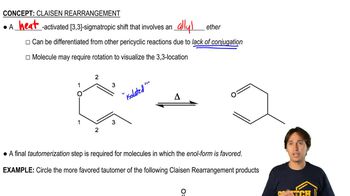
Definition of Claisen Rearrangement

Carbocation Stability

Carbocation stability is a crucial concept in organic chemistry, as the stability of the carbocation intermediate formed during the pinacol rearrangement significantly influences the reaction pathway and product distribution. Tertiary carbocations are more stable than secondary, which are more stable than primary, due to hyperconjugation and inductive effects from surrounding alkyl groups.
추천 영상:
05:58
Determining Carbocation Stability

Mechanism of Rearrangement

Understanding the mechanism of the pinacol rearrangement is essential for predicting the products. The mechanism involves protonation of the hydroxyl group, loss of water to form a carbocation, and subsequent rearrangement of the carbocation to a more stable form, followed by deprotonation to yield the final carbonyl product. This stepwise process highlights the importance of both the initial substrate structure and the reaction conditions.
추천 영상:
06:08
Definition of Claisen Rearrangement