Ethers can be converted into radicals, some more easily than others. Which of the following radicals is more stable, and thus, more likely to form?
Ch. 13 - Alcohols, Ethers and Related Compounds: Substitution and Elimination

Mullins1st EditionOrganic Chemistry: A Learner Centered ApproachISBN: 9780137566471당신이 사용하는 게 아니라요?교과서 변경
모든 교과서
Mullins 1st Edition
Ch. 13 - Alcohols, Ethers and Related Compounds: Substitution and Elimination
문제 66c
Mullins 1st Edition
Ch. 13 - Alcohols, Ethers and Related Compounds: Substitution and Elimination
문제 66c12장, 문제 66c
Predict the product of the following reactions. [Two of them are Williamson ether syntheses. Why isn't the other?].
(c) 
검증된 단계별 안내1
Identify the reactants: Methanol (CH₃OH) and a secondary alkyl chloride (2-chlorocyclohexane).
Recognize the role of sodium (Na⁰) in the reaction. Sodium metal reacts with alcohols to form alkoxides. Here, sodium will react with methanol to form sodium methoxide (CH₃O⁻ Na⁺) and hydrogen gas.
Understand the Williamson ether synthesis mechanism: It involves the reaction of an alkoxide ion with a primary alkyl halide to form an ether. The alkoxide ion acts as a nucleophile.
Analyze the structure of the alkyl halide: 2-chlorocyclohexane is a secondary alkyl halide. Williamson ether synthesis is most effective with primary alkyl halides due to steric hindrance and potential for elimination reactions with secondary and tertiary halides.
Conclude why this reaction is not a Williamson ether synthesis: The secondary nature of the alkyl halide (2-chlorocyclohexane) makes it prone to elimination reactions rather than substitution, which is why this reaction does not proceed via the Williamson ether synthesis pathway.

비슷한 문제에 대한 검증된 영상 답변:
이 영상 해법은 위 문제에 도움이 된다고 튜터들이 추천한 것입니다.
주요 개념
질문에 올바르게 답하기 위해 반드시 이해해야 하는 핵심 개념들은 다음과 같습니다.
Williamson Ether Synthesis
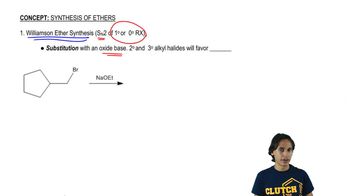
Williamson ether synthesis is a method for creating ethers through the reaction of an alkoxide ion with a primary alkyl halide. This reaction typically involves an SN2 mechanism, where the nucleophile (alkoxide) attacks the electrophile (alkyl halide) to form the ether. The choice of reactants is crucial, as steric hindrance can hinder the reaction, making it less effective with secondary or tertiary alkyl halides.
추천 영상:
The Mechanism of Williamson Ether Synthesis.
SN2 Mechanism
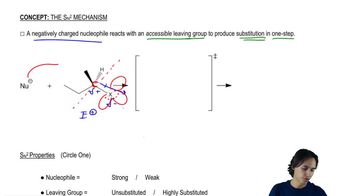
The SN2 mechanism is a type of nucleophilic substitution reaction characterized by a single concerted step where the nucleophile attacks the electrophile, leading to the displacement of a leaving group. This mechanism is favored by primary substrates due to less steric hindrance, allowing for a more effective attack. Understanding the SN2 mechanism is essential for predicting the outcomes of reactions in Williamson ether synthesis.
추천 영상:
Drawing the SN2 Mechanism
Reactivity of Alkyl Halides
The reactivity of alkyl halides in nucleophilic substitution reactions depends on their structure. Primary alkyl halides react readily via the SN2 mechanism, while secondary and tertiary halides are more likely to undergo elimination reactions or SN1 mechanisms due to steric hindrance. Recognizing the type of alkyl halide involved is crucial for predicting whether a reaction will proceed via Williamson ether synthesis or another pathway.
추천 영상:
How to name alkyl halides
관련 실천
교과서 질문
911
views
교과서 질문
Why is the SN1 reaction shown an inefficient way of synthesizing ethers?
1065
views
교과서 질문
Two different Williamson ether syntheses can be used to make the compound in (a). Show them. The compound in (b), however, can only be made one way. Show it and explain why a second Williamson ether synthesis is not possible.
(a)
992
views
교과서 질문
Predict the product of the following reactions. [Two of them are Williamson ether syntheses. Why isn't the other?].
(a)
1071
views
교과서 질문
Predict the product of the following reactions. [Two of them are Williamson ether syntheses. Why isn't the other?].
(b)
683
views
교과서 질문
Starting with hydrogen sulfide, suggest a synthesis of the following thioether that makes use of two different haloalkanes.
886
views