Ch. 13 - Alcohols, Ethers and Related Compounds: Substitution and Elimination
Mullins - Organic Chemistry: A Learner Centered Approach 1st Edition
Mullins1st EditionOrganic Chemistry: A Learner Centered ApproachISBN: 9780137566471당신이 사용하는 게 아니라요?교과서 변경
12장, 문제 83

Reaction of the acetylide with the epoxide shown will not form the desired product. What side reaction occurs instead? Why?
Reaction scheme showing acetylide and epoxide; desired product not formed, indicating a side reaction occurs instead.

검증된 단계별 안내
1
Step 1: Understand the reactivity of acetylides. Acetylides are strong nucleophiles due to the negative charge on the carbon atom. They are also strong bases, which can lead to side reactions in the presence of acidic or proton-donating groups.
Step 2: Analyze the structure of the epoxide. Epoxides are three-membered cyclic ethers with significant ring strain, making them susceptible to nucleophilic attack. However, the reaction conditions and the nature of the nucleophile can influence the outcome.
Step 3: Consider the basicity of the acetylide. As a strong base, the acetylide can abstract a proton from any available acidic hydrogen in the reaction mixture, such as from water, alcohols, or other proton sources, instead of attacking the epoxide.
Step 4: Evaluate the competition between nucleophilic attack and proton abstraction. If proton abstraction occurs, the acetylide is converted into a neutral alkyne, which is no longer nucleophilic and cannot react with the epoxide to form the desired product.
Step 5: Conclude the side reaction. The side reaction involves the acetylide acting as a base and abstracting a proton, leading to the formation of an alkyne and preventing the desired nucleophilic attack on the epoxide.

비슷한 문제에 대한 검증된 영상 답변:

이 영상 해법은 위 문제에 도움이 된다고 튜터들이 추천한 것입니다.

주요 개념

질문에 올바르게 답하기 위해 반드시 이해해야 하는 핵심 개념들은 다음과 같습니다.

Acetylide Nucleophiles

Acetylide ions are strong nucleophiles derived from terminal alkynes. They can attack electrophilic centers, such as carbon atoms in epoxides, leading to nucleophilic substitution reactions. However, their reactivity can also lead to side reactions, especially when the electrophile is sterically hindered or reactive in other ways.
추천 영상:
08:27
Nucleophilic Addition

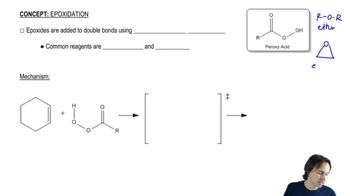
Epoxide Reactivity

Epoxides are three-membered cyclic ethers that are highly reactive due to the strain in their ring structure. They can undergo nucleophilic attack at the less hindered carbon atom, but if steric hindrance or other factors are present, the reaction may not proceed as expected. Understanding the regioselectivity of epoxide reactions is crucial for predicting the outcome of reactions involving acetylides.
추천 영상:
02:19
General properties of epoxidation.

Side Reactions in Organic Chemistry

Side reactions are unintended reactions that occur alongside the desired reaction, often leading to byproducts. In the case of acetylide and epoxide reactions, side reactions can occur due to the formation of more stable intermediates or competing pathways, such as ring-opening of the epoxide by other nucleophiles or elimination reactions. Recognizing these possibilities is essential for predicting reaction outcomes.
추천 영상:
가이드 코스
2:52
Side-Chain Reactions of Substituted Pyridines Concept 3