Ch. 13 - Alcohols, Ethers and Related Compounds: Substitution and Elimination
Mullins - Organic Chemistry: A Learner Centered Approach 1st Edition
Mullins1st EditionOrganic Chemistry: A Learner Centered ApproachISBN: 9780137566471당신이 사용하는 게 아니라요?교과서 변경
12장, 문제 14d

Suggest a reagent to carry out each of the following conversions to an alcohol.
(d) Chemical structure transformation showing a reagent needed to convert an alkene to an alcohol.

검증된 단계별 안내
1
Step 1: Identify the starting material and the type of alcohol desired (primary, secondary, or tertiary). This will help determine the appropriate reagent and reaction pathway.
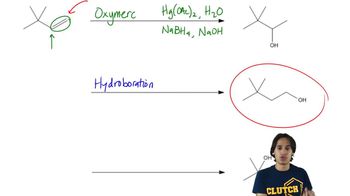
Step 2: If the starting material is an alkene, consider using hydroboration-oxidation (BH₃ followed by H₂O₂/NaOH) or oxymercuration-demercuration (Hg(OAc)₂ followed by NaBH₄) to convert the alkene into an alcohol.
Step 3: If the starting material is a carbonyl compound (aldehyde or ketone), use a reducing agent such as NaBH₄ or LiAlH₄ to reduce the carbonyl group to an alcohol. NaBH₄ is suitable for mild reductions, while LiAlH₄ is more reactive and can reduce esters and carboxylic acids as well.
Step 4: If the starting material is an alkyl halide, consider using aqueous NaOH or KOH for nucleophilic substitution to form an alcohol. Alternatively, you can use Ag₂O in water for a gentler conversion.
Step 5: If the starting material is an ester or carboxylic acid, use LiAlH₄ followed by acidic workup to reduce the compound to an alcohol. This reagent is strong enough to break the ester bond and reduce carboxylic acids.

비슷한 문제에 대한 검증된 영상 답변:

이 영상 해법은 위 문제에 도움이 된다고 튜터들이 추천한 것입니다.
영상 길이:
4m

주요 개념

질문에 올바르게 답하기 위해 반드시 이해해야 하는 핵심 개념들은 다음과 같습니다.

Alcohol Functional Group

Alcohols are organic compounds characterized by the presence of one or more hydroxyl (-OH) groups attached to a carbon atom. Understanding the structure and reactivity of alcohols is crucial for predicting how they can be synthesized or converted from other functional groups. The properties of alcohols, such as polarity and hydrogen bonding, influence their behavior in chemical reactions.
추천 영상:
02:36
Identifying Functional Groups

Reduction Reactions

Reduction reactions involve the gain of electrons or the addition of hydrogen to a molecule, often resulting in the conversion of carbonyl compounds (like aldehydes or ketones) to alcohols. Common reducing agents include lithium aluminum hydride (LiAlH4) and sodium borohydride (NaBH4). Recognizing the type of carbonyl compound and the appropriate reducing agent is essential for successfully converting it to an alcohol.
추천 영상:
07:12
Reductive Amination

Reagents for Alcohol Synthesis

Various reagents can be employed to synthesize alcohols from different starting materials. For example, Grignard reagents can react with carbonyl compounds to form alcohols, while hydrolysis of alkyl halides can also yield alcohols. Understanding the specific reagents and their mechanisms of action is vital for selecting the correct one for a given conversion.
추천 영상:
01:37
Forming alcohols through Hydroboration-Oxidation.