Ch. 13 - Alcohols, Ethers and Related Compounds: Substitution and Elimination
Mullins - Organic Chemistry: A Learner Centered Approach 1st Edition
Mullins1st EditionOrganic Chemistry: A Learner Centered ApproachISBN: 9780137566471당신이 사용하는 게 아니라요?교과서 변경
12장, 문제 32

When SOCl2 is used in place of HCl, only one product results. Why are these conditions better?

검증된 단계별 안내
1
Identify the starting material and the reagent: The starting material is an alcohol, and the reagent is thionyl chloride (SOCl2) in the presence of a base (Et3N).
Understand the mechanism: SOCl2 converts alcohols to alkyl chlorides through a mechanism that involves the formation of an intermediate chlorosulfite ester, which then undergoes a nucleophilic substitution reaction.
Compare with HCl: When HCl is used, the reaction typically proceeds through an SN1 mechanism, which can lead to carbocation rearrangements and result in multiple products.
Explain the advantage of SOCl2: The use of SOCl2 avoids carbocation formation and rearrangement, leading to a single product through an SN2 mechanism, which is stereospecific and retains the configuration of the starting material.
Conclude why SOCl2 is better: SOCl2 provides a more controlled and predictable reaction pathway, resulting in a single, desired product without side reactions or rearrangements.

비슷한 문제에 대한 검증된 영상 답변:

이 영상 해법은 위 문제에 도움이 된다고 튜터들이 추천한 것입니다.

주요 개념

질문에 올바르게 답하기 위해 반드시 이해해야 하는 핵심 개념들은 다음과 같습니다.

Thionyl Chloride (SOCl₂) Reactivity

Thionyl chloride is a reagent commonly used in organic synthesis for converting alcohols into alkyl chlorides. Its unique reactivity allows for the formation of a single product due to the mechanism involving the formation of a cyclic intermediate, which leads to a more controlled reaction pathway compared to other reagents like HCl.
추천 영상:
01:36
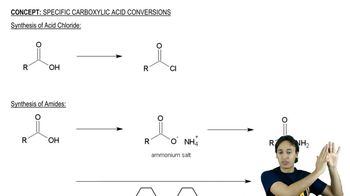
Synthesis of Acid Chlorides

Mechanism of Nucleophilic Substitution

Nucleophilic substitution is a fundamental reaction in organic chemistry where a nucleophile replaces a leaving group in a molecule. The mechanism can proceed via either an SN1 or SN2 pathway, influencing the number of products formed. SOCl₂ typically favors the SN2 mechanism, resulting in a single product due to its steric and electronic properties.
추천 영상:
01:47
Nucleophiles and Electrophiles can react in Substitution Reactions.

Selectivity in Organic Reactions

Selectivity refers to the ability of a reaction to produce a specific product over others. In the case of SOCl₂, the reaction conditions and the nature of the reagent lead to high selectivity, minimizing side reactions and by-products. This contrasts with HCl, which can lead to multiple products due to its less selective nature in nucleophilic substitution.
추천 영상:
02:17
Identifying organic molecules