Ch. 14 - Structural Identification 1: Infrared Spectroscopy and Mass Spectrometry
Mullins - Organic Chemistry: A Learner Centered Approach 1st Edition
Mullins1st EditionOrganic Chemistry: A Learner Centered ApproachISBN: 9780137566471당신이 사용하는 게 아니라요?교과서 변경
13장, 문제 15a

Choose the bond in each pair that you expect to vibrate at the higher wavenumber.
(a) C―N vs. C = N

검증된 단계별 안내
1
Understand that the wavenumber in infrared spectroscopy is related to the frequency of vibration of a bond, which depends on the bond strength and the masses of the atoms involved.
Recall that stronger bonds typically vibrate at higher frequencies, and thus have higher wavenumbers.
Compare the bond strengths: a C=N (carbon-nitrogen double bond) is generally stronger than a C-N (carbon-nitrogen single bond).
Consider the bond order: a double bond (C=N) has a higher bond order than a single bond (C-N), indicating a stronger bond.
Conclude that the C=N bond is expected to vibrate at a higher wavenumber than the C-N bond due to its greater bond strength and higher bond order.

비슷한 문제에 대한 검증된 영상 답변:

이 영상 해법은 위 문제에 도움이 된다고 튜터들이 추천한 것입니다.
영상 길이:
3m

주요 개념

질문에 올바르게 답하기 위해 반드시 이해해야 하는 핵심 개념들은 다음과 같습니다.

Bond Vibrational Frequency

Bond vibrational frequency refers to the energy required for a bond to stretch or compress during vibration. It is influenced by the bond strength and the masses of the atoms involved. Stronger bonds and lighter atoms typically result in higher vibrational frequencies, which are measured in wavenumbers (cm⁻¹).
추천 영상:
06:00
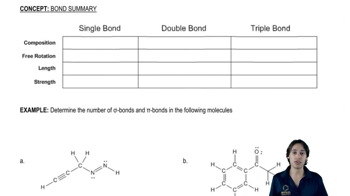
Single bonds, double bonds, and triple bonds.

Single vs. Double Bonds

Single bonds, like C―N, are generally weaker than double bonds, such as C=N, because double bonds involve more shared electrons, increasing bond strength. This increased strength in double bonds leads to higher vibrational frequencies compared to single bonds, as more energy is required to alter the bond length.
추천 영상:
06:00
Single bonds, double bonds, and triple bonds.

Wavenumber

Wavenumber is a unit of frequency used in spectroscopy, defined as the number of wave cycles per unit distance (cm⁻¹). It is directly related to the energy of molecular vibrations; higher wavenumbers indicate higher energy vibrations. In infrared spectroscopy, wavenumbers are used to identify functional groups based on their characteristic vibrational frequencies.