A carboxylic acid can be converted to an ester using the conditions shown. Explain how a comparison of an IR spectrum of the reactant(s) and product can be used to determine whether the reaction was successful or not.
Ch. 14 - Structural Identification 1: Infrared Spectroscopy and Mass Spectrometry

Mullins1st EditionOrganic Chemistry: A Learner Centered ApproachISBN: 9780137566471당신이 사용하는 게 아니라요?교과서 변경
모든 교과서
Mullins 1st Edition
Ch. 14 - Structural Identification 1: Infrared Spectroscopy and Mass Spectrometry
문제 48a
Mullins 1st Edition
Ch. 14 - Structural Identification 1: Infrared Spectroscopy and Mass Spectrometry
문제 48a13장, 문제 48a
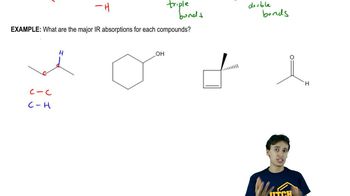
Identify the important bands you would expect to find in an IR spectrum for the following molecules.
(a) 
검증된 단계별 안내1
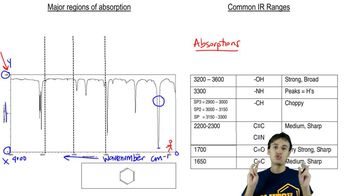
Understand the basics of IR spectroscopy: Infrared (IR) spectroscopy is a technique used to identify functional groups in organic molecules based on the absorption of infrared light at specific wavelengths. Different functional groups absorb IR light at characteristic frequencies, resulting in distinct bands in the IR spectrum.
Identify the functional groups present in the molecule: Examine the molecular structure to determine which functional groups are present. Common functional groups include alcohols, amines, carbonyls, alkenes, and alkynes, each of which has characteristic IR absorption bands.
Determine the characteristic IR absorption frequencies: Once the functional groups are identified, refer to standard IR frequency tables to find the typical absorption ranges for each group. For example, O-H stretches in alcohols typically appear around 3200-3600 cm-1, while C=O stretches in carbonyls appear around 1700 cm-1.
Consider the molecular environment: The presence of other atoms or groups in the molecule can shift the absorption frequencies slightly. For instance, hydrogen bonding can broaden and shift the O-H stretch, while conjugation can lower the frequency of C=O stretches.
Compile the expected IR bands: Based on the identified functional groups and their characteristic frequencies, list the important IR bands you would expect to find in the spectrum of the molecule. This list will help in analyzing the IR spectrum and confirming the presence of specific functional groups.

비슷한 문제에 대한 검증된 영상 답변:
이 영상 해법은 위 문제에 도움이 된다고 튜터들이 추천한 것입니다.
주요 개념
질문에 올바르게 답하기 위해 반드시 이해해야 하는 핵심 개념들은 다음과 같습니다.
Infrared (IR) Spectroscopy
Infrared spectroscopy is an analytical technique used to identify functional groups in molecules by measuring the absorption of infrared light, which causes molecular vibrations. Each type of bond and functional group absorbs IR radiation at characteristic frequencies, producing a spectrum that can be used to deduce structural information about the molecule.
추천 영상:
General Features of IR Spect
Functional Groups
Functional groups are specific groups of atoms within molecules that have characteristic properties and reactivity. In IR spectroscopy, different functional groups absorb at different frequencies, allowing for their identification. For example, carbonyl groups (C=O) typically show strong absorption around 1700 cm⁻¹, while hydroxyl groups (O-H) absorb broadly around 3200-3600 cm⁻¹.
추천 영상:
Identifying Functional Groups
Characteristic IR Absorption Bands
Characteristic IR absorption bands are specific frequency ranges where particular bonds or functional groups absorb infrared light. These bands are used to identify the presence of certain functional groups in a molecule. For instance, C-H stretching vibrations appear around 2800-3000 cm⁻¹, while N-H stretching is observed near 3300-3500 cm⁻¹, aiding in the structural analysis of organic compounds.
추천 영상:
Major IR absorptions
관련 실천
교과서 질문
988
views
교과서 질문
Identify the important bands you would expect to find in an IR spectrum for the following molecules.
(c)
995
views
교과서 질문
What functional groups might be present in the IR spectra for the molecules with the given molecular formulas. [Be sure to use the molecular formula in your analysis.]
(b) C₃H₄O₄
<IMAGE>
1283
views
교과서 질문
Based on Hooke's law, choose the bond in each pair that you expect to vibrate at a higher wavenumber.
(f) C―S vs C=O
1168
views
교과서 질문
Based on Hooke's law, choose the bond in each pair that you expect to vibrate at a higher wavenumber.
(e) C=N vs C≡N
1307
views
교과서 질문
Choose the bond in each pair that you expect to have the more intense stretching band
(b) C=O vs. C=N
982
views