
Ch. 15 - Structural Identification 2: Nuclear Magnetic Resonance Spectroscopy
Mullins - Organic Chemistry: A Learner Centered Approach 1st Edition
Mullins1st EditionOrganic Chemistry: A Learner Centered ApproachISBN: 9780137566471당신이 사용하는 게 아니라요?교과서 변경
14장, 문제 3

(a) Rank the following bonds in terms of the strength of their bond dipole (1 = weakest, 6 = strongest).
(b) Which carbon has the largest δ⁺ ?
C―F, C―Br, C―I, C―H, C―C, C―Cl

검증된 단계별 안내
1
Step 1: Understand the concept of bond dipole strength. Bond dipole strength is determined by the difference in electronegativity between the two atoms forming the bond. The greater the electronegativity difference, the stronger the bond dipole.
Step 2: Compare the electronegativity values of the atoms involved in each bond. Fluorine (F) has the highest electronegativity, followed by chlorine (Cl), bromine (Br), iodine (I), hydrogen (H), and carbon (C). Use the periodic table to confirm these values.
Step 3: Rank the bonds based on the electronegativity difference between carbon and the other atom in the bond. For example, the C―F bond will have the strongest dipole because fluorine has the highest electronegativity difference with carbon, while the C―C bond will have the weakest dipole because both atoms are the same and have no electronegativity difference.
Step 4: To determine which carbon has the largest δ⁺ (partial positive charge), focus on the bond where carbon is bonded to the atom with the highest electronegativity. The larger the electronegativity difference, the more δ⁺ charge is induced on the carbon atom.
Step 5: Summarize the ranking of bond dipole strengths and identify the carbon with the largest δ⁺ based on the electronegativity differences calculated in the previous steps.

비슷한 문제에 대한 검증된 영상 답변:

이 영상 해법은 위 문제에 도움이 된다고 튜터들이 추천한 것입니다.
영상 길이:
7m

주요 개념

질문에 올바르게 답하기 위해 반드시 이해해야 하는 핵심 개념들은 다음과 같습니다.

Electronegativity

Electronegativity is a measure of an atom's ability to attract and hold onto electrons in a chemical bond. In the context of the given bonds, the differences in electronegativity between carbon and the halogens (F, Br, Cl, I) determine the bond dipole strength. The greater the electronegativity difference, the stronger the bond dipole, leading to a more polarized bond.
추천 영상:
1:47
Electronegativity

Bond Dipole Moment

The bond dipole moment is a vector quantity that represents the polarity of a bond. It is calculated as the product of the charge difference between the two atoms and the distance between them. In this question, the bond dipole strength is influenced by both the electronegativity of the atoms involved and the bond length, with stronger dipoles indicating a greater separation of charge.
추천 영상:
01:46
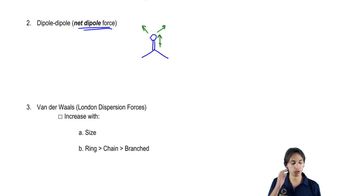
How dipole-dipole forces work.

Partial Charges (δ⁺ and δ⁻)

Partial charges (δ⁺ and δ⁻) arise in polar covalent bonds due to the unequal sharing of electrons. The atom with higher electronegativity acquires a partial negative charge (δ⁻), while the less electronegative atom acquires a partial positive charge (δ⁺). In this question, identifying which carbon has the largest δ⁺ involves analyzing the bonds it forms with halogens, particularly focusing on the bond dipole strengths.
추천 영상:
01:34
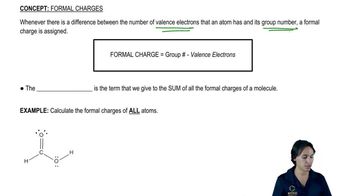
Calculating formal and net charge.