교과서 질문
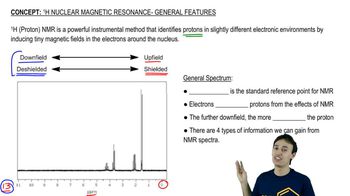
How many sets of equivalent hydrogens are present in the molecule that resulted in this NMR spectrum? [Recall that some signals can be split into multiple peaks—they are still just one signal.]
<IMAGE>
1567
views

 Mullins 1st EditionCh. 15 - Structural Identification 2: Nuclear Magnetic Resonance Spectroscopy문제 15c
 검증된 단계별 안내
 10:06
10:06
 3:11
3:11 00:25
00:25How many sets of equivalent hydrogens are present in the molecule that resulted in this NMR spectrum? [Recall that some signals can be split into multiple peaks—they are still just one signal.]
<IMAGE>
How many sets of equivalent hydrogens are in each molecule shown?
(c)
If rotation is restricted, as in the case of the molecule shown, the hydrogens labeled a and b are nonequivalent. Why?
Without worrying about the relative location of the signals (i.e., the chemical shift) or the splitting patterns, draw a spectrum of the following molecule. Be sure to label each signal based on the set of equivalent hydrogens to which it corresponds.
How many unique ¹H NMR signals would you expect in an NMR spectrum for the following molecules?
(a)
How many unique ¹H NMR signals would you expect in an NMR spectrum for the following molecules?
(b)