Ch. 16 - Metals in Organic Chemistry
Mullins - Organic Chemistry: A Learner Centered Approach 1st Edition
Mullins1st EditionOrganic Chemistry: A Learner Centered ApproachISBN: 9780137566471당신이 사용하는 게 아니라요?교과서 변경
15장, 문제 5b

Calculate Keq for the following acid–base reactions.
(b)

검증된 단계별 안내
1
Step 1: Identify the acid and base on both sides of the reaction. Determine which species is donating a proton (acid) and which is accepting a proton (base).
Step 2: Look up the pKa values of the acids on both sides of the reaction. The pKa value indicates the strength of an acid; lower pKa values correspond to stronger acids.
Step 3: Use the relationship between pKa and equilibrium constant (Kₑq). The formula is: Keq=10(pKa(acid)-pKa(conjugate acid))
Step 4: Subtract the pKa of the conjugate acid from the pKa of the acid to find the exponent for the equilibrium constant calculation.
Step 5: Express the equilibrium constant (Kₑq) as a power of 10 using the calculated exponent. This will give you the relative favorability of the reaction.

비슷한 문제에 대한 검증된 영상 답변:

이 영상 해법은 위 문제에 도움이 된다고 튜터들이 추천한 것입니다.
영상 길이:
5m

주요 개념

질문에 올바르게 답하기 위해 반드시 이해해야 하는 핵심 개념들은 다음과 같습니다.

Acid-Base Reactions

Acid-base reactions involve the transfer of protons (H⁺ ions) between reactants. In these reactions, acids donate protons while bases accept them. Understanding the nature of the acids and bases involved is crucial for predicting the direction of the reaction and calculating equilibrium constants.
추천 영상:
02:49
The Lewis definition of acids and bases.

Equilibrium Constant (Kₑq)

The equilibrium constant (Kₑq) quantifies the ratio of the concentrations of products to reactants at equilibrium for a given reaction. For acid-base reactions, Kₑq can be derived from the concentrations of the conjugate acids and bases involved. It provides insight into the strength of the acids and bases and the favorability of the reaction.
추천 영상:
02:19
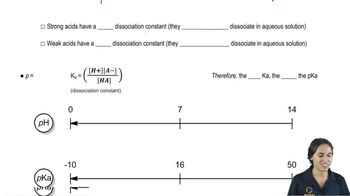
The relationship between equilibrium constant and pKa.

Conjugate Acid-Base Pairs

Conjugate acid-base pairs consist of an acid and its corresponding base that differ by a single proton. When an acid donates a proton, it forms its conjugate base, and vice versa. Recognizing these pairs is essential for calculating Kₑq, as it helps in determining the relative strengths of the acids and bases in the reaction.
추천 영상:
가이드 코스
2:56
Base Pairing Concept 1