Based on the stereochemical result alone, how can you tell that this reaction does not proceed by an Sₙ2 mechanism?
Ch. 16 - Metals in Organic Chemistry

Mullins1st EditionOrganic Chemistry: A Learner Centered ApproachISBN: 9780137566471당신이 사용하는 게 아니라요?교과서 변경
15장, 문제 33b
Predict the product of the diorganocuprate cross-coupling reactions shown.
(b) 
검증된 단계별 안내1
Identify the reactants involved in the diorganocuprate cross-coupling reaction. Typically, this involves an organohalide and a diorganocuprate reagent, such as R2CuLi.
Understand the role of the diorganocuprate reagent. In this reaction, the diorganocuprate (R2CuLi) acts as a nucleophile, where one of the R groups will replace the halide (X) on the organohalide (R'-X).
Determine which R group from the diorganocuprate will participate in the coupling. Generally, one of the R groups will transfer to the organohalide, forming a new carbon-carbon bond.
Predict the product by replacing the halide (X) on the organohalide with the R group from the diorganocuprate. The resulting product will be R'-R, where R' is the original organic group from the organohalide.
Consider any stereochemical or regiochemical outcomes if applicable. In many cases, the reaction proceeds with retention of configuration, but it's important to verify based on the specific reactants involved.

비슷한 문제에 대한 검증된 영상 답변:
이 영상 해법은 위 문제에 도움이 된다고 튜터들이 추천한 것입니다.
영상 길이:
3m주요 개념
질문에 올바르게 답하기 위해 반드시 이해해야 하는 핵심 개념들은 다음과 같습니다.
Diorganocuprate Reagents
Diorganocuprate reagents, typically denoted as R2CuLi, are organocopper compounds used in organic synthesis for cross-coupling reactions. They are formed by reacting organolithium compounds with copper(I) salts. These reagents are known for their ability to couple with organic halides, forming new carbon-carbon bonds, which is crucial in predicting the products of such reactions.
추천 영상:
Reagents
Cross-Coupling Reaction Mechanism
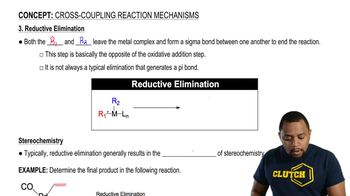
Cross-coupling reactions involve the formation of a new carbon-carbon bond between two different organic groups. In the context of diorganocuprate reactions, the mechanism typically involves oxidative addition of the organic halide to the copper center, followed by reductive elimination to form the coupled product. Understanding this mechanism is essential for predicting the outcome of the reaction.
추천 영상:
Cross-Coupling Reaction Mechanisms
Regioselectivity in Coupling Reactions
Regioselectivity refers to the preference for the formation of one constitutional isomer over another in a chemical reaction. In diorganocuprate cross-coupling reactions, regioselectivity is influenced by the nature of the organic groups and the halide involved. Recognizing how these factors affect the position and type of the new bond formed is key to accurately predicting the product structure.
추천 영상:
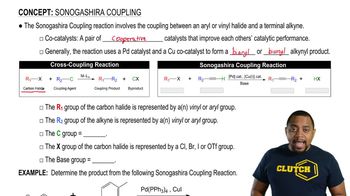
Sonogashira Coupling Reaction
관련 실천
교과서 질문
880
views
교과서 질문
Predict the product of the following Sonogashira coupling reactions.
(b)
890
views
교과서 질문
The trimethylsilyl (TMS) group, used as a protecting group for alcohols, can also be used a protecting group for terminal alkynes. Show how TMS-acetylene could be used to link together two aryl halides using the Sonogashira reaction. [Hint: Deprotection of the TMS-acetylene can be done using KF in H₂O.]
1019
views
교과서 질문
Predict the product of the diorganocuprate cross-coupling reactions shown.
(a)
1008
views
교과서 질문
Predict the product of the diorganocuprate cross-coupling reactions shown.
(c)
939
views
교과서 질문
Suggest a synthesis of the following molecule starting with the reagents shown, using cuprate cross-coupling as the key step.
851
views