Ch. 16 - Metals in Organic Chemistry
Mullins - Organic Chemistry: A Learner Centered Approach 1st Edition
Mullins1st EditionOrganic Chemistry: A Learner Centered ApproachISBN: 9780137566471당신이 사용하는 게 아니라요?교과서 변경
15장, 문제 25b

Predict the product of the following Stille coupling reactions.
(b) Chemical reaction diagram illustrating a Stille coupling reaction with reactants and conditions for product prediction.

검증된 단계별 안내
1
Identify the reactants involved in the Stille coupling reaction. The first reactant is a lithium-substituted aromatic compound, and the second reactant is a pyridine derivative with bromine and fluorine substituents.
Understand the role of each reagent in the reaction. Bu3SnCl is used to convert the lithium-substituted aromatic compound into a stannane, which is necessary for the Stille coupling. Pd(PPh3)4 is the palladium catalyst that facilitates the coupling reaction between the stannane and the bromine-substituted pyridine.
Convert the lithium-substituted aromatic compound into a stannane by reacting it with Bu3SnCl. This step involves the formation of a carbon-tin bond, replacing the lithium atom with a tributyltin group.
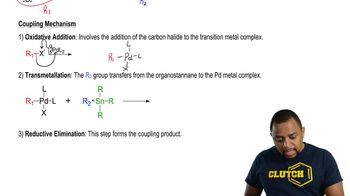
Recognize the mechanism of the Stille coupling reaction. The palladium catalyst will facilitate the transmetalation step, where the stannane transfers its organic group to the palladium, forming a palladium-organic complex.
Predict the final product of the reaction. The organic group from the stannane will couple with the pyridine derivative at the position where the bromine was located, resulting in the formation of a new carbon-carbon bond between the aromatic ring and the pyridine ring.

비슷한 문제에 대한 검증된 영상 답변:

이 영상 해법은 위 문제에 도움이 된다고 튜터들이 추천한 것입니다.
영상 길이:
4m

주요 개념

질문에 올바르게 답하기 위해 반드시 이해해야 하는 핵심 개념들은 다음과 같습니다.

Stille Coupling Reaction

The Stille coupling reaction is a palladium-catalyzed cross-coupling process that forms carbon-carbon bonds between organotin compounds and organic halides or pseudohalides. It is widely used in organic synthesis due to its ability to form complex molecules with high selectivity and functional group tolerance. The reaction typically involves a tin reagent, a halide, and a palladium catalyst.
추천 영상:
03:20
Stille Reaction

Organotin Reagents

Organotin reagents, such as Bu3SnCl, are key components in Stille coupling reactions. These reagents contain a tin atom bonded to organic groups, which can transfer an organic moiety to a palladium catalyst. The organotin compound in the reaction serves as a nucleophile, facilitating the formation of a new carbon-carbon bond with the organic halide or pseudohalide.
추천 영상:
01:52
Reagents

Palladium Catalysis

Palladium catalysis is crucial in Stille coupling reactions, where palladium complexes, like Pd(PPh3)4, facilitate the formation of carbon-carbon bonds. The palladium catalyst undergoes oxidative addition with the organic halide, transmetalation with the organotin reagent, and reductive elimination to form the coupled product. This catalytic cycle is essential for the efficiency and selectivity of the reaction.
추천 영상:
가이드 코스
2:31
Nucleophilic Catalysis Concept 1