Ch. 17 - Carbonyl Addition Reactions: Aldehydes and Ketones
Mullins - Organic Chemistry: A Learner Centered Approach 1st Edition
Mullins1st EditionOrganic Chemistry: A Learner Centered ApproachISBN: 9780137566471당신이 사용하는 게 아니라요?교과서 변경
16장, 문제 8c

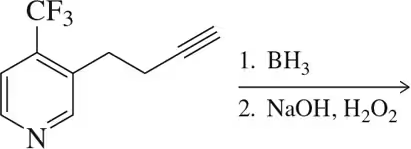
Predict the product of the following aldehyde/ketone syntheses.
(c) Chemical structure showing a CF3 group attached to a nitrogen-containing ring, with alkyne and hydroboration reaction steps.

검증된 단계별 안내
1
Identify the starting materials and reagents used in the synthesis. Aldehyde and ketone syntheses often involve specific reactions such as oxidation of alcohols, hydration of alkynes, or Friedel-Crafts acylation.
Determine the functional group transformations involved. For example, if the starting material is a primary alcohol, it can be oxidized to an aldehyde using reagents like PCC (Pyridinium chlorochromate). If it is a secondary alcohol, it can be oxidized to a ketone using reagents like chromic acid (H₂CrO₄).
Analyze the reaction mechanism. For instance, in the oxidation of alcohols, the hydroxyl group is converted into a carbonyl group through the loss of hydrogen atoms and the addition of oxygen.
Consider any regioselectivity or stereoselectivity in the reaction. For example, in the hydration of alkynes, the Markovnikov or anti-Markovnikov rule may dictate the position of the carbonyl group in the product.
Draw the structure of the predicted product based on the reaction type, starting material, and reagents. Ensure that the product contains the correct functional group (aldehyde or ketone) and that the carbon skeleton remains consistent with the starting material.

비슷한 문제에 대한 검증된 영상 답변:

이 영상 해법은 위 문제에 도움이 된다고 튜터들이 추천한 것입니다.
영상 길이:
4m

주요 개념

질문에 올바르게 답하기 위해 반드시 이해해야 하는 핵심 개념들은 다음과 같습니다.

Aldehydes and Ketones

Aldehydes and ketones are organic compounds characterized by the presence of a carbonyl group (C=O). Aldehydes have at least one hydrogen atom attached to the carbonyl carbon, while ketones have two carbon groups attached. Understanding their structure is crucial for predicting reaction products in organic synthesis.
추천 영상:
03:57
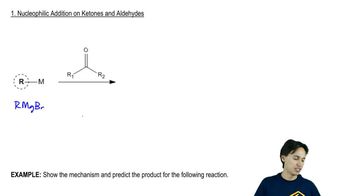
Nucleophilic Addition on Ketones and Aldehydes

Nucleophilic Addition Reactions

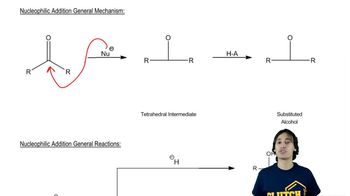
Nucleophilic addition reactions are fundamental in organic chemistry, particularly for carbonyl compounds. In these reactions, a nucleophile attacks the electrophilic carbon of the carbonyl group, leading to the formation of a tetrahedral intermediate. This process is key to predicting the products formed when aldehydes or ketones react with various nucleophiles.
추천 영상:
08:27
Nucleophilic Addition

Synthesis Pathways

Synthesis pathways refer to the step-by-step methods used to create organic compounds from simpler substances. In the context of aldehyde and ketone syntheses, understanding different pathways, such as oxidation of alcohols or reactions with Grignard reagents, is essential for predicting the final products. Familiarity with these pathways allows chemists to design efficient synthetic routes.
추천 영상:
가이드 코스
2:13
Energy Production In Biochemical Pathways Concept 1