Ch. 18 - Nucleophilic Acyl Substitution 1: Carboxylic Acids
Mullins - Organic Chemistry: A Learner Centered Approach 1st Edition
Mullins1st EditionOrganic Chemistry: A Learner Centered ApproachISBN: 9780137566471당신이 사용하는 게 아니라요?교과서 변경
17장, 문제 59

When a chemist attempted the following reaction sequence, the desired product was not formed.
(a) Why?
(b) Suggest a solution to the problem. [Think about chemistry from the end of Chapter 13.]
Chemical reaction sequence showing reactants and products, with "not formed" highlighted, indicating an unsuccessful reaction.

검증된 단계별 안내
1
The reaction sequence involves the formation of a Grignard reagent from the bromide compound. The first step is the reaction of the alkyl bromide with magnesium in diethyl ether (Et₂O) to form the Grignard reagent. This reagent is highly reactive and can be used to form carbon-carbon bonds.
The presence of the hydroxyl group (OH) in the starting material is problematic because Grignard reagents are strong bases and will react with the acidic hydrogen of the hydroxyl group, leading to the formation of an alkoxide rather than the desired Grignard reagent.
To solve this problem, the hydroxyl group should be protected before the formation of the Grignard reagent. A common method is to convert the alcohol into a silyl ether using a reagent like trimethylsilyl chloride (TMSCl) in the presence of a base such as imidazole.
Once the hydroxyl group is protected, the Grignard reagent can be formed without interference from the acidic hydrogen. The Grignard reagent can then react with carbon dioxide (CO₂) to form the carboxylate intermediate.
Finally, the carboxylate intermediate is quenched with an acid, such as H₃O⁺, to yield the carboxylic acid product. After the reaction is complete, the protecting group can be removed to regenerate the hydroxyl group, yielding the desired product.

비슷한 문제에 대한 검증된 영상 답변:

이 영상 해법은 위 문제에 도움이 된다고 튜터들이 추천한 것입니다.
영상 길이:
4m

주요 개념

질문에 올바르게 답하기 위해 반드시 이해해야 하는 핵심 개념들은 다음과 같습니다.

Reaction Mechanisms

Understanding reaction mechanisms is crucial in organic chemistry as it describes the step-by-step process by which reactants transform into products. Each mechanism outlines the movement of electrons, the formation and breaking of bonds, and the intermediates involved. A clear grasp of these mechanisms helps chemists predict the outcomes of reactions and troubleshoot when desired products are not formed.
추천 영상:
02:16
Heck Reaction Mechanism

Functional Groups

Functional groups are specific groups of atoms within molecules that are responsible for the characteristic chemical reactions of those molecules. Recognizing the functional groups present in reactants and products is essential for predicting reactivity and understanding how changes in these groups can affect the outcome of a reaction. This knowledge is vital when suggesting modifications to achieve the desired product.
추천 영상:
02:36
Identifying Functional Groups

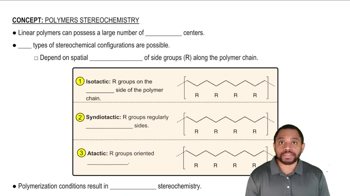
Stereochemistry

Stereochemistry involves the study of the spatial arrangement of atoms in molecules and how this affects their chemical behavior. The three-dimensional orientation of functional groups can significantly influence reaction pathways and product formation. Understanding stereochemistry is important for addressing issues related to selectivity and yield in organic reactions, particularly when the desired product has specific stereochemical requirements.
추천 영상:
가이드 코스
1:38
Polymer Stereochemistry Concept 1