Ch. 19 - Nucleophilic Acyl Substitution 2: Carboxylic Acid Derivatives
Mullins - Organic Chemistry: A Learner Centered Approach 1st Edition
Mullins1st EditionOrganic Chemistry: A Learner Centered ApproachISBN: 9780137566471당신이 사용하는 게 아니라요?교과서 변경
18장, 문제 14

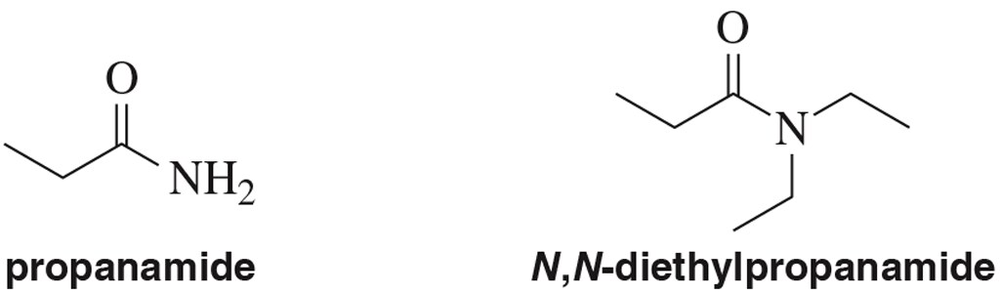
How would you expect the IR and ¹H NMR spectra for propanamide and N,N-diethylpropanamide to differ?
Chemical structures of propanamide and N,N-diethylpropanamide, highlighting differences in amide groups.

검증된 단계별 안내
1
Identify the functional groups present in propanamide and N,N-diethylpropanamide. Propanamide contains an amide group, while N,N-diethylpropanamide has an amide group with additional ethyl groups attached to the nitrogen.
For IR spectroscopy, focus on the characteristic absorption bands. Propanamide will show a strong absorption band for the C=O stretch of the amide around 1640-1690 cm⁻¹ and N-H stretches around 3200-3500 cm⁻¹. N,N-diethylpropanamide will also show the C=O stretch, but the N-H stretch will be absent due to the substitution of hydrogen atoms with ethyl groups.
In the ¹H NMR spectrum, analyze the chemical environment of hydrogen atoms. Propanamide will have signals for the amide N-H protons, typically appearing as a broad singlet. N,N-diethylpropanamide will lack these N-H signals but will show additional signals for the ethyl groups, including triplets and quartets due to the CH₂ and CH₃ groups.
Consider the splitting patterns in the ¹H NMR spectra. In propanamide, the CH₃ group will appear as a triplet due to coupling with the adjacent CH₂ group, which will appear as a quartet. In N,N-diethylpropanamide, the ethyl groups will show similar splitting patterns, but with additional complexity due to the presence of two ethyl groups.
Compare the chemical shifts in both compounds. The presence of the electron-withdrawing carbonyl group in both compounds will deshield nearby protons, but the additional ethyl groups in N,N-diethylpropanamide will cause shifts in the chemical environment, leading to different chemical shifts compared to propanamide.

비슷한 문제에 대한 검증된 영상 답변:

이 영상 해법은 위 문제에 도움이 된다고 튜터들이 추천한 것입니다.

주요 개념

질문에 올바르게 답하기 위해 반드시 이해해야 하는 핵심 개념들은 다음과 같습니다.

Infrared (IR) Spectroscopy

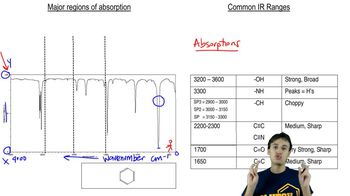
IR spectroscopy is a technique used to identify functional groups in organic compounds by measuring the absorption of infrared light, which causes molecular vibrations. Key absorptions for amides include the carbonyl stretch around 1650 cm⁻¹ and N-H stretches near 3300 cm⁻¹. In N,N-diethylpropanamide, the absence of N-H stretches due to substitution with ethyl groups will differentiate its IR spectrum from propanamide.
추천 영상:
16:04
General Features of IR Spect

¹H Nuclear Magnetic Resonance (NMR) Spectroscopy

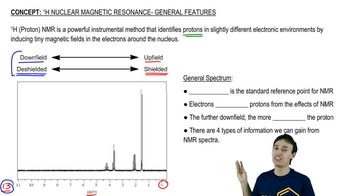
¹H NMR spectroscopy provides information about the hydrogen atoms in a molecule, including their environment and connectivity. In propanamide, the N-H protons will appear as distinct signals, while in N,N-diethylpropanamide, these signals will be absent, replaced by signals from the ethyl groups. The chemical shifts and splitting patterns will help distinguish between the two compounds.
추천 영상:
10:06
General NMR Features

Amide Functional Group

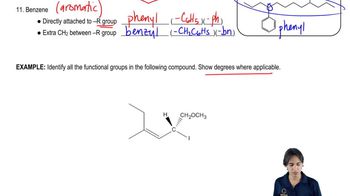
Amides are characterized by a carbonyl group (C=O) bonded to a nitrogen atom. In propanamide, the amide group includes hydrogen atoms bonded to nitrogen, which are detectable in both IR and NMR spectra. In N,N-diethylpropanamide, the nitrogen is bonded to ethyl groups instead, altering the spectral characteristics by removing N-H signals and introducing signals from the ethyl groups.
추천 영상:
02:36
Identifying Functional Groups