Ch. 19 - Nucleophilic Acyl Substitution 2: Carboxylic Acid Derivatives
Mullins - Organic Chemistry: A Learner Centered Approach 1st Edition
Mullins1st EditionOrganic Chemistry: A Learner Centered ApproachISBN: 9780137566471당신이 사용하는 게 아니라요?교과서 변경
18장, 문제 37

Show a mechanism for the lithium aluminum hydride reduction of benzoic anhydride.
Mechanism showing lithium aluminum hydride reducing benzoic anhydride to a phenolic compound.

검증된 단계별 안내
1
Identify the functional groups in benzoic anhydride. It contains two acyl groups (carbonyl groups attached to an oxygen atom).
Recognize that lithium aluminum hydride (LiAlH4) is a strong reducing agent, capable of reducing acyl groups to alcohols.
In the first step of the mechanism, the hydride ion (H-) from LiAlH4 attacks the carbonyl carbon of one of the acyl groups, leading to the formation of a tetrahedral intermediate.
The tetrahedral intermediate collapses, expelling the leaving group (the other acyl group), and forming a benzoate ion.
The benzoate ion is further reduced by another hydride ion from LiAlH4 to form benzyl alcohol. The process is repeated for the second acyl group, resulting in two equivalents of benzyl alcohol after quenching with water (H3O+).

비슷한 문제에 대한 검증된 영상 답변:

이 영상 해법은 위 문제에 도움이 된다고 튜터들이 추천한 것입니다.

주요 개념

질문에 올바르게 답하기 위해 반드시 이해해야 하는 핵심 개념들은 다음과 같습니다.

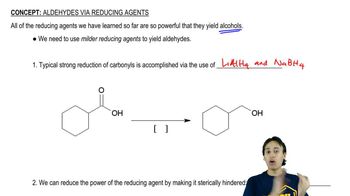
Lithium Aluminum Hydride (LiAlH4)

Lithium aluminum hydride is a powerful reducing agent commonly used in organic chemistry. It can reduce a variety of functional groups, including carboxylic acids and anhydrides, to their corresponding alcohols. The mechanism involves the transfer of hydride ions (H-) from the LiAlH4 to the electrophilic carbonyl carbon, leading to the formation of an alkoxide intermediate.
추천 영상:
02:07
Why LiAlH4 doesn't work

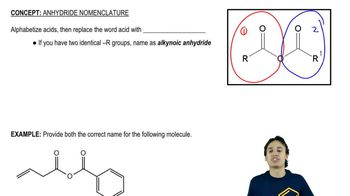
Benzoic Anhydride

Benzoic anhydride is a compound formed from two benzoic acid molecules through the removal of water. It contains two carbonyl groups and is reactive towards nucleophiles due to the electrophilic nature of the carbonyl carbons. Understanding its structure and reactivity is crucial for predicting the outcome of its reduction by lithium aluminum hydride.
추천 영상:
03:35
Anhydride Nomenclature

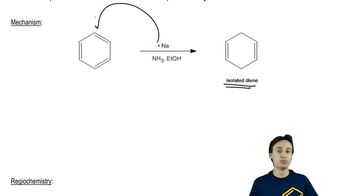
Reduction Mechanism

The reduction mechanism describes the step-by-step process by which a compound gains electrons or hydrogen, resulting in a decrease in oxidation state. In the case of benzoic anhydride reduction, the mechanism involves nucleophilic attack by the hydride ion on the carbonyl carbon, followed by protonation of the resulting alkoxide to yield the alcohol product. This understanding is essential for illustrating the reaction pathway.
추천 영상:
04:40
Birch Reduction Mechanism