A chemistry student drew the following incorrect electron configuration for carbon. (a) Correct the diagram.
Ch. 2 - General Chemistry Translated: Finding the Electrons

Mullins1st EditionOrganic Chemistry: A Learner Centered ApproachISBN: 9780137566471당신이 사용하는 게 아니라요?교과서 변경
1장, 문제 8
Chlorine exists as one of two isotopes with atomic masses of 34.969 amu (35Cl) and 36.966 amu (37Cl) . Calculate the relative abundance of 35Cl and 37Cl based on the average atomic mass of 35.453 amu.
검증된 단계별 안내1
Define the variables: Let the relative abundance of ³⁵Cl be x, and the relative abundance of ³⁷Cl be (1 - x), since the total abundance must equal 1.
Write the equation for the average atomic mass of chlorine: .
Distribute the terms in the equation: , which expands to .
Combine like terms: Simplify the equation to .
Rearrange the equation to solve for x: Subtract 36.966 from both sides, then divide by -1.997 to isolate x. The value of x represents the relative abundance of ³⁵Cl, and (1 - x) gives the relative abundance of ³⁷Cl.

비슷한 문제에 대한 검증된 영상 답변:
이 영상 해법은 위 문제에 도움이 된다고 튜터들이 추천한 것입니다.
영상 길이:
6m주요 개념
질문에 올바르게 답하기 위해 반드시 이해해야 하는 핵심 개념들은 다음과 같습니다.
Isotopes
Isotopes are variants of a chemical element that have the same number of protons but different numbers of neutrons, resulting in different atomic masses. For chlorine, the isotopes ³⁵Cl and ³⁷Cl have atomic masses of 34.969 amu and 36.966 amu, respectively. Understanding isotopes is crucial for calculations involving average atomic mass and relative abundance.
추천 영상:
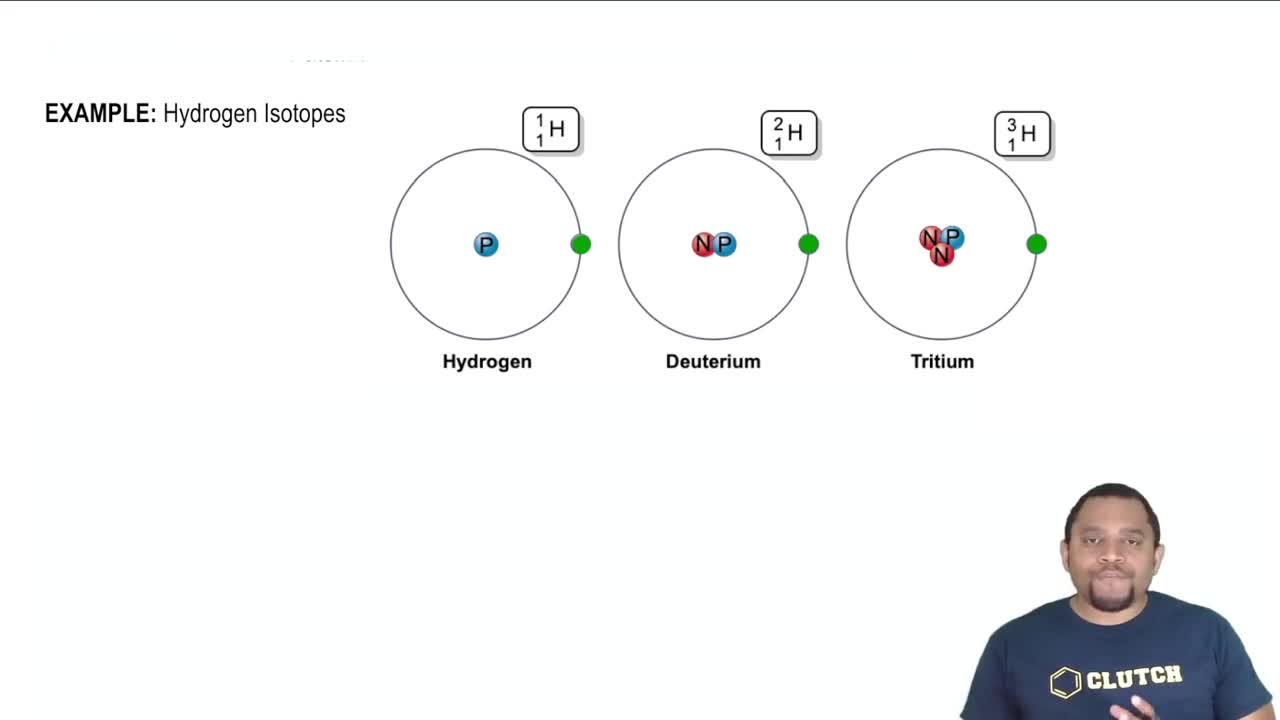
Understanding the hydrogen isotopes.
Average Atomic Mass
The average atomic mass of an element is a weighted average of the masses of its isotopes, taking into account their relative abundances. In this case, the average atomic mass of chlorine is given as 35.453 amu. This value is essential for determining the proportions of each isotope present in a sample.
추천 영상:
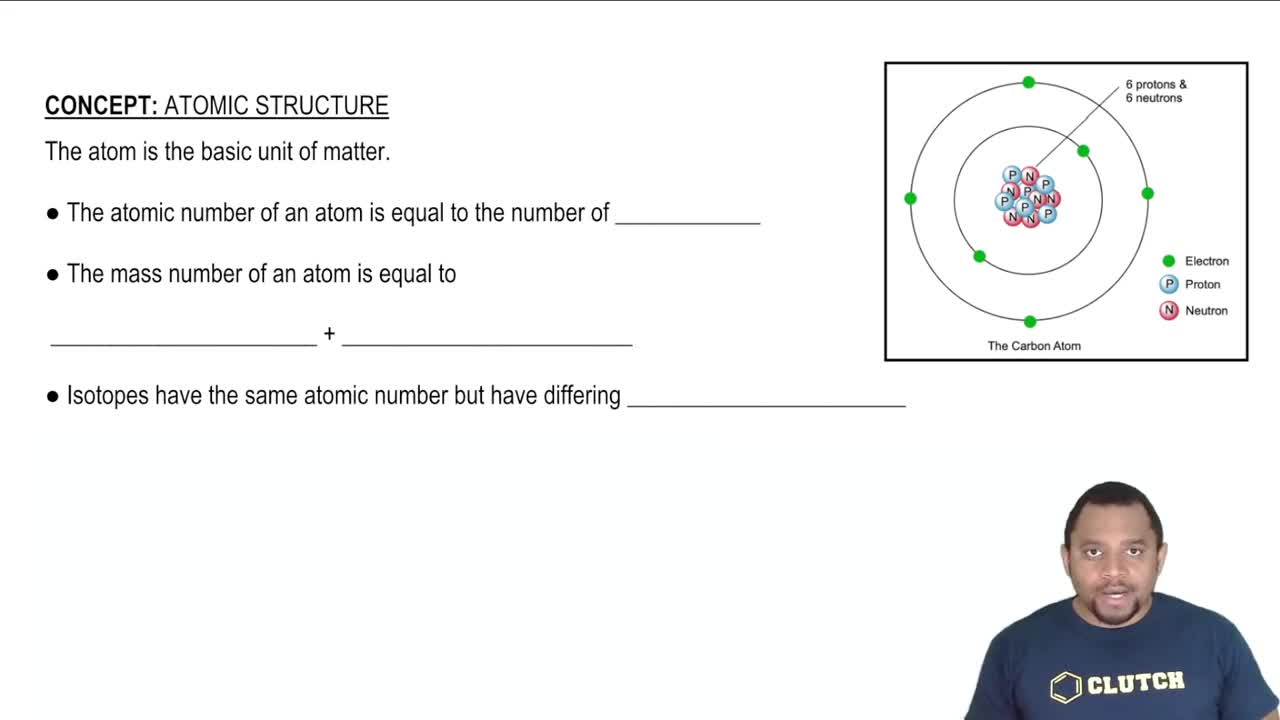
The difference between atomic numbers and atomic mass.
Relative Abundance
Relative abundance refers to the proportion of each isotope of an element present in a sample, usually expressed as a percentage. To calculate the relative abundance of ³⁵Cl and ³⁷Cl, one can set up equations based on the average atomic mass and the known masses of the isotopes. This concept is fundamental for understanding how isotopes contribute to the overall atomic mass of an element.
추천 영상:
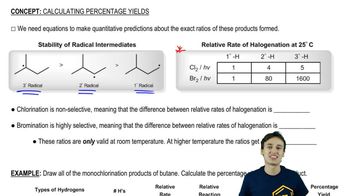
Explaining relative rates of halogenation.
관련 실천
교과서 질문
861
views
교과서 질문
Why is argon considered to be so stable that it is referred to as a noble gas?
1466
views
교과서 질문
Would you expect electrons in the 2s or 3s orbital to be more reactive? Why?
1251
views
교과서 질문
How many valence shell electrons do each of the following elements contain? How many new bonds can each form?
(c) O
1283
views
교과서 질문
A chemistry student drew the following incorrect electron configuration for carbon. (b) Which rule wasn't followed by the student?
1436
views
교과서 질문
Bromine-79 (50.7% abundance) has an atomic mass of 78.918 amu, whereas bromine-81 (49.3% abundance) has an atomic mass of 80.916 amu. From these data, calculate the average atomic mass of bromine that you would expect to see in the periodic table.
1281
views