Ch. 21 - Conjugated Systems 1: Stability and Addition Reactions
Mullins - Organic Chemistry: A Learner Centered Approach 1st Edition
Mullins1st EditionOrganic Chemistry: A Learner Centered ApproachISBN: 9780137566471당신이 사용하는 게 아니라요?교과서 변경
20장, 문제 60a

The reactivity of cyclopropanes often mimics that of alkenes.
(a) On the basis of this, suggest a mechanism for the following reaction.
Chemical reaction diagram showing cyclopropane with ethyl groups and sodium methylthio in water, leading to a product with thioether.

검증된 단계별 안내
1
Understand the problem: Cyclopropanes are known to exhibit reactivity similar to alkenes due to the strain in their three-membered ring. This strain makes the C-C bonds more reactive, often undergoing reactions that resemble alkene chemistry, such as electrophilic addition or ring-opening reactions.
Analyze the reaction: Identify the reactants, products, and any reagents or conditions provided in the reaction. If the reaction involves an electrophile or nucleophile, consider how the cyclopropane might interact with it.
Propose the first step of the mechanism: If the reaction involves an electrophile (e.g., H⁺ or Br⁺), the cyclopropane can act as a nucleophile. The strained C-C bond can break, forming a carbocation intermediate. Represent this step using curved arrows to show electron movement.
Consider the intermediate: After the initial bond-breaking step, evaluate the stability of the carbocation intermediate. If possible, resonance or rearrangement may occur to stabilize the intermediate.
Propose the final step: Depending on the reaction conditions, the carbocation intermediate may react with a nucleophile (e.g., water, halide ion) to form the final product. Use curved arrows to show the nucleophilic attack and complete the mechanism.

비슷한 문제에 대한 검증된 영상 답변:

이 영상 해법은 위 문제에 도움이 된다고 튜터들이 추천한 것입니다.
영상 길이:
1m

주요 개념

질문에 올바르게 답하기 위해 반드시 이해해야 하는 핵심 개념들은 다음과 같습니다.

Cyclopropane Reactivity

Cyclopropanes are small cyclic alkenes that exhibit unique reactivity due to their strained three-membered ring structure. This strain makes them more reactive than typical alkenes, allowing them to undergo reactions such as ring-opening or addition reactions. Understanding this reactivity is crucial for predicting the outcomes of reactions involving cyclopropanes.
추천 영상:
01:49
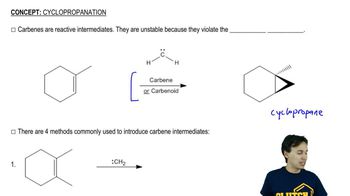
General properties of cyclopropanation.

Mechanism of Electrophilic Addition

Electrophilic addition is a fundamental reaction mechanism in organic chemistry where an electrophile reacts with a nucleophile, leading to the formation of a more stable product. In the context of cyclopropanes, this mechanism can involve the opening of the ring and the addition of reagents across the double bond-like character of the cyclopropane, similar to how alkenes react.
추천 영상:
05:39
Features of Addition Mechanisms.

Transition States and Reaction Pathways

In organic reactions, transition states represent the highest energy state during the transformation of reactants to products. Understanding the transition states and the energy barriers involved in the reaction pathways is essential for predicting the feasibility and rate of reactions. This concept is particularly relevant when analyzing the mechanisms of cyclopropane reactions, as the strain in the ring influences these factors.
추천 영상:
06:55
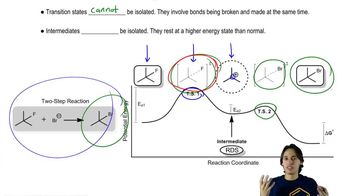
Intermediates vs. Transition States