Ch. 21 - Conjugated Systems 1: Stability and Addition Reactions
Mullins - Organic Chemistry: A Learner Centered Approach 1st Edition
Mullins1st EditionOrganic Chemistry: A Learner Centered ApproachISBN: 9780137566471당신이 사용하는 게 아니라요?교과서 변경
20장, 문제 16

Why is this not a viable representation of the ψ2, molecular orbital of buta-1,3-diene?

검증된 단계별 안내
1
Step 1: Understand the molecular orbital ψ₂ of buta-1,3-diene. Buta-1,3-diene has four π molecular orbitals (ψ₁, ψ₂, ψ₃, ψ₄) formed by the combination of four p orbitals from the conjugated system. ψ₂ is the second-lowest energy molecular orbital and has one node where the phase of the p orbitals changes.
Step 2: Analyze the image provided. The image shows a representation of p orbitals with alternating phases (+ and -) along the conjugated system. However, the pattern of phases does not correspond to the expected configuration of ψ₂.
Step 3: Recall the characteristics of ψ₂. In ψ₂, there should be one node (a region where the wavefunction changes sign) between the p orbitals. This node divides the molecule into two regions with opposite phases. The image provided does not show a single node; instead, it shows multiple phase changes, which is inconsistent with ψ₂.
Step 4: Compare the image to the correct representation of ψ₂. The correct representation of ψ₂ should have one node, with two p orbitals on one side of the node having the same phase and the other two p orbitals on the opposite side having the opposite phase. The image provided does not match this description.
Step 5: Conclude why the representation is not viable. The image fails to accurately depict the single node and phase distribution characteristic of ψ₂. Instead, it shows an incorrect arrangement of phases, making it an invalid representation of the ψ₂ molecular orbital of buta-1,3-diene.

비슷한 문제에 대한 검증된 영상 답변:

이 영상 해법은 위 문제에 도움이 된다고 튜터들이 추천한 것입니다.
영상 길이:
5m

주요 개념

질문에 올바르게 답하기 위해 반드시 이해해야 하는 핵심 개념들은 다음과 같습니다.

Molecular Orbitals

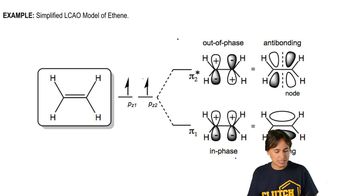
Molecular orbitals (MOs) are formed by the linear combination of atomic orbitals (LCAO) when atoms bond together. In buta-1,3-diene, the π molecular orbitals arise from the overlap of p orbitals on adjacent carbon atoms. Understanding the arrangement and energy levels of these MOs is crucial for analyzing the stability and reactivity of the molecule.
추천 영상:
08:41
Review of Molecular Orbitals

Node Concept

Nodes are regions in a molecular orbital where the probability of finding an electron is zero. In the context of buta-1,3-diene, the presence of nodes in the π molecular orbitals indicates the distribution of electron density. A viable representation of the ψ₂ orbital must accurately depict the number and placement of nodes, which affects the orbital's energy and stability.
추천 영상:
가이드 코스
1:21
The Citric Acid Cycle Concept 10

Charge Distribution

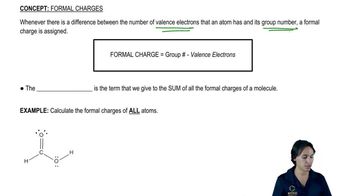
Charge distribution refers to how electron density is spread across a molecule's orbitals. In buta-1,3-diene, the charge distribution in the π molecular orbitals influences the molecule's reactivity and stability. An accurate representation must show how positive and negative charges are distributed, particularly in the context of resonance structures and the overall electronic configuration.
추천 영상:
01:34
Calculating formal and net charge.