Ch. 22 - Conjugated Systems 2: Pericyclic Reactions
Mullins - Organic Chemistry: A Learner Centered Approach 1st Edition
Mullins1st EditionOrganic Chemistry: A Learner Centered ApproachISBN: 9780137566471당신이 사용하는 게 아니라요?교과서 변경
21장, 문제 62

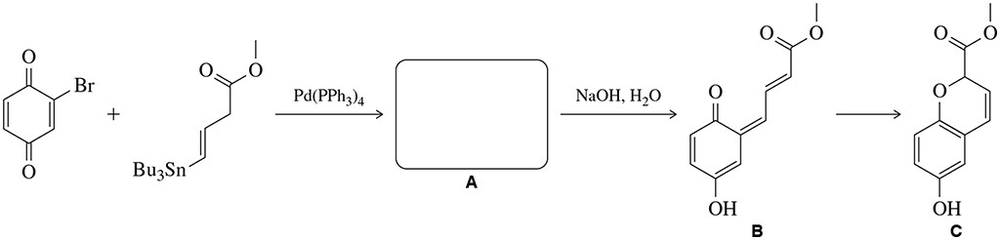
The product of the Stille coupling reaction (A) tautomerizes in a basic solution to give compound B. B spontaneously converts to C. (a) Propose a structure for A. (b) Suggest a mechanism for the conversion of A to B.
Chemical reaction diagram showing the Stille coupling reaction and the conversion of compound A to B and C.

검증된 단계별 안내
1
Step 1: Understand the Stille coupling reaction. The Stille coupling is a palladium-catalyzed cross-coupling reaction between an organotin compound (R-SnR3) and an organic halide (R'-X) to form a new carbon-carbon bond. Identify the possible reactants and the product (A) based on the given information.
Step 2: Propose a structure for compound A. Based on the Stille coupling reaction, determine the structure of A by combining the organic halide and the organotin compound. Ensure the product has the correct connectivity and stereochemistry.
Step 3: Analyze the tautomerization of A to B in a basic solution. Tautomerization typically involves the migration of a proton and the shift of a double bond. Propose a mechanism where a base abstracts a proton from A, leading to the formation of an enolate intermediate, which then rearranges to form compound B.
Step 4: Propose a structure for compound B. Based on the tautomerization mechanism, determine the structure of B. Ensure that the structure reflects the rearrangement of bonds and the new protonation state.
Step 5: Suggest a mechanism for the spontaneous conversion of B to C. Analyze the structure of B and propose a plausible reaction pathway (e.g., intramolecular cyclization, elimination, or rearrangement) that leads to the formation of compound C. Ensure the mechanism is consistent with the chemical properties of B and the stability of C.

비슷한 문제에 대한 검증된 영상 답변:

이 영상 해법은 위 문제에 도움이 된다고 튜터들이 추천한 것입니다.

주요 개념

질문에 올바르게 답하기 위해 반드시 이해해야 하는 핵심 개념들은 다음과 같습니다.

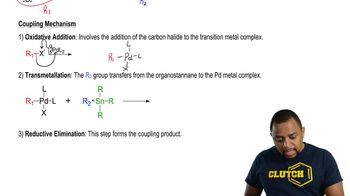
Stille Coupling Reaction

The Stille coupling reaction is a cross-coupling reaction that involves the reaction of an organostannane with an organic halide in the presence of a palladium catalyst. This reaction is widely used in organic synthesis to form carbon-carbon bonds, allowing for the construction of complex molecules. Understanding the nature of the reactants and the conditions required for this reaction is crucial for proposing the structure of compound A.
추천 영상:
03:20
Stille Reaction

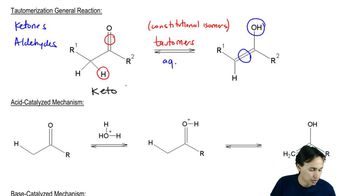
Tautomerization

Tautomerization is a chemical reaction that involves the interconversion of two isomers, typically involving the relocation of a proton and a shift of a double bond. In the context of the question, the product of the Stille reaction (compound A) undergoes tautomerization in a basic solution to form compound B. Recognizing the structural changes that occur during tautomerization is essential for understanding how to propose the correct structure for A.
추천 영상:
05:11
Tautomerization Mechanisms

Mechanism of Organic Reactions

The mechanism of an organic reaction describes the step-by-step process by which reactants are converted into products, detailing the breaking and forming of bonds. For the conversion of compound A to B, it is important to outline the specific steps involved, including any intermediates and transition states. A clear understanding of reaction mechanisms is vital for accurately suggesting how A transforms into B.
추천 영상:
02:17
Identifying organic molecules