Ch. 22 - Conjugated Systems 2: Pericyclic Reactions
Mullins - Organic Chemistry: A Learner Centered Approach 1st Edition
Mullins1st EditionOrganic Chemistry: A Learner Centered ApproachISBN: 9780137566471당신이 사용하는 게 아니라요?교과서 변경
21장, 문제 23d

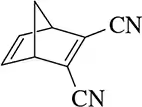
Give the diene and dienophile that could be used to make the following Diels–Alder products.
(d) Chemical structure of a bicyclic compound with two cyano groups (CN) attached to a six-membered ring.

검증된 단계별 안내
1
Identify the Diels–Alder product structure given in the problem. The Diels–Alder reaction involves a [4+2] cycloaddition between a diene and a dienophile, resulting in a cyclohexene ring.
Examine the product to determine the positions of the new sigma bonds formed during the reaction. This will help in identifying the original diene and dienophile.
Determine the structure of the diene. The diene is a conjugated system with two double bonds. Look for the part of the product that corresponds to the four-carbon chain with two double bonds.
Identify the dienophile. The dienophile is typically an alkene or alkyne that reacts with the diene. In the product, it corresponds to the two-carbon unit that forms a new bond with the diene.
Consider any substituents or stereochemistry in the product. This can provide clues about the substituents on the diene and dienophile before the reaction. Ensure that the stereochemistry in the product matches the expected outcome of the Diels–Alder reaction.

비슷한 문제에 대한 검증된 영상 답변:

이 영상 해법은 위 문제에 도움이 된다고 튜터들이 추천한 것입니다.

주요 개념

질문에 올바르게 답하기 위해 반드시 이해해야 하는 핵심 개념들은 다음과 같습니다.

Diels–Alder Reaction

The Diels–Alder reaction is a [4+2] cycloaddition reaction between a conjugated diene and a dienophile, typically an alkene or alkyne, to form a six-membered ring. This reaction is a cornerstone of organic synthesis due to its ability to form complex cyclic structures in a stereospecific manner. Understanding the electronic and steric requirements of both the diene and dienophile is crucial for predicting the outcome of the reaction.
추천 영상:
04:02
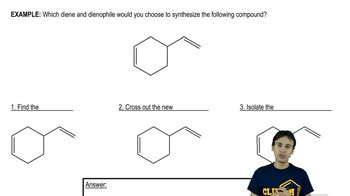
Diels-Alder Retrosynthesis

Conjugated Diene

A conjugated diene consists of two double bonds separated by a single bond, allowing for electron delocalization across the π-system. This delocalization stabilizes the diene and is essential for its reactivity in the Diels–Alder reaction. The s-cis conformation of the diene is particularly reactive, as it allows the p-orbitals to overlap effectively with those of the dienophile during the cycloaddition process.
추천 영상:
03:27
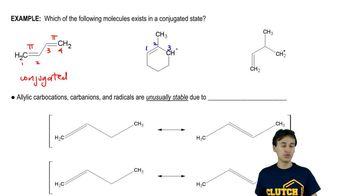
Conjugated states

Dienophile

A dienophile is an electron-deficient alkene or alkyne that participates in the Diels–Alder reaction by reacting with a conjugated diene. The presence of electron-withdrawing groups on the dienophile enhances its reactivity by making it more electrophilic. Understanding the electronic nature of the dienophile is crucial for predicting the regioselectivity and stereochemistry of the Diels–Alder product.
추천 영상:
09:48
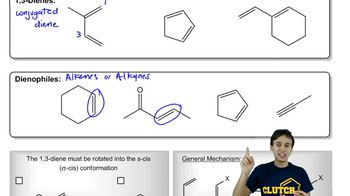
General Features