Ch. 22 - Conjugated Systems 2: Pericyclic Reactions
Mullins - Organic Chemistry: A Learner Centered Approach 1st Edition
Mullins1st EditionOrganic Chemistry: A Learner Centered ApproachISBN: 9780137566471당신이 사용하는 게 아니라요?교과서 변경
21장, 문제 30c

Predict the product of the following electrocyclic reactions.
(c) Chemical structure illustrating an electrocyclic reaction with a hexagonal ring and a hydrogen atom, followed by light energy input.

검증된 단계별 안내
1
Identify the type of electrocyclic reaction: The given reaction involves a cyclohexene derivative undergoing an electrocyclic reaction under photochemical conditions (indicated by 'hv').
Determine the number of π-electrons involved: The cyclohexene derivative has a conjugated π-system with 4 π-electrons.
Apply Woodward-Hoffmann rules: For a 4 π-electron system under photochemical conditions, the reaction proceeds via a conrotatory mechanism.
Predict the stereochemistry of the product: In a conrotatory process, the substituents at the termini of the π-system rotate in the same direction. This will affect the stereochemistry of the product.
Draw the product structure: Based on the conrotatory motion, draw the resulting cyclobutene product, ensuring the correct stereochemistry is depicted as a result of the rotation.

비슷한 문제에 대한 검증된 영상 답변:

이 영상 해법은 위 문제에 도움이 된다고 튜터들이 추천한 것입니다.
영상 길이:
3m

주요 개념

질문에 올바르게 답하기 위해 반드시 이해해야 하는 핵심 개념들은 다음과 같습니다.

Electrocyclic Reactions

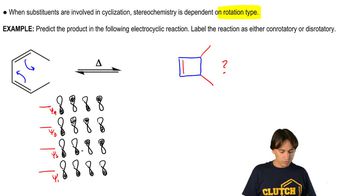
Electrocyclic reactions are a type of pericyclic reaction where a conjugated pi-electron system undergoes a ring closure or opening. These reactions are characterized by the concerted movement of electrons, leading to the formation or breaking of a sigma bond. The stereochemistry of the product is determined by the conrotatory or disrotatory motion of the substituents, which is influenced by the number of pi electrons and whether the reaction is thermally or photochemically induced.
추천 영상:
08:11
Predicting Electrocyclic Products

Photochemical Activation

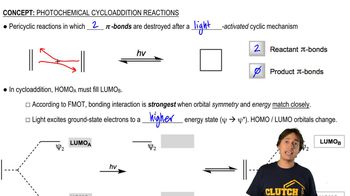
Photochemical activation involves the absorption of light energy (hv) to promote electrons to higher energy states, facilitating reactions that might not occur under thermal conditions. In electrocyclic reactions, light can induce a change in the stereochemical pathway, often leading to a disrotatory mechanism for systems with 4n pi electrons. This is crucial for determining the stereochemistry of the product in the given reaction.
추천 영상:
09:36
MO Theory of Photochemical Cycloadditions

Conrotatory and Disrotatory Mechanisms

Conrotatory and disrotatory mechanisms describe the stereochemical pathways in electrocyclic reactions. In a conrotatory process, substituents rotate in the same direction, while in a disrotatory process, they rotate in opposite directions. The choice between these mechanisms depends on the number of pi electrons and whether the reaction is thermally or photochemically driven, affecting the final stereochemistry of the product.
추천 영상:
04:32
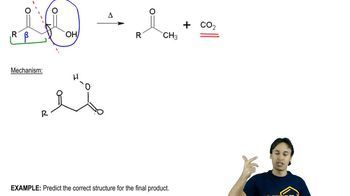
General Mechanism