Ch. 23 - Benzene 1: Aromatic Stability and Substitution Reactions
Mullins - Organic Chemistry: A Learner Centered Approach 1st Edition
Mullins1st EditionOrganic Chemistry: A Learner Centered ApproachISBN: 9780137566471당신이 사용하는 게 아니라요?교과서 변경
22장, 문제 59b

Predict the products of the following reactions.
(b) Chemical reaction diagram illustrating the Negishi coupling with reactants, reagents, and products indicated.

검증된 단계별 안내
1
Identify the type of reaction: The reaction involves an aryl iodide and an organozinc reagent in the presence of a palladium catalyst, indicating a Negishi coupling reaction.
Understand the role of each component: The aryl iodide will act as the electrophile, while the organozinc compound will serve as the nucleophile. The palladium catalyst facilitates the coupling process.
Predict the coupling: In a Negishi coupling, the carbon atom bonded to the zinc in the organozinc reagent will form a new bond with the carbon atom bonded to the iodine in the aryl iodide.
Consider the regioselectivity: The reaction will proceed with the formation of a new carbon-carbon bond between the aryl group and the alkyl chain from the organozinc reagent, replacing the iodine atom.
Draw the product: The final product will be a compound where the aryl group is directly connected to the alkyl chain, with the iodine atom replaced by the alkyl group from the organozinc reagent.

비슷한 문제에 대한 검증된 영상 답변:

이 영상 해법은 위 문제에 도움이 된다고 튜터들이 추천한 것입니다.
영상 길이:
3m

주요 개념

질문에 올바르게 답하기 위해 반드시 이해해야 하는 핵심 개념들은 다음과 같습니다.

Negishi Coupling

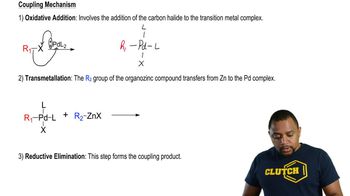
Negishi coupling is a cross-coupling reaction that forms carbon-carbon bonds between an organozinc compound and an organic halide, typically catalyzed by palladium. This reaction is highly useful in organic synthesis for constructing complex molecules. The presence of a palladium catalyst, such as Pd(PPh3)4, facilitates the transfer of the organic group from zinc to the halide, resulting in the formation of a new C-C bond.
추천 영상:
03:18
Negishi Coupling Reaction

Role of Palladium Catalyst

Palladium catalysts, like Pd(PPh3)4, play a crucial role in facilitating cross-coupling reactions by enabling the oxidative addition of the organic halide and the subsequent transmetalation with the organozinc reagent. The catalyst undergoes a series of redox cycles, allowing the coupling partners to form a new carbon-carbon bond efficiently. The choice of ligand, such as triphenylphosphine (PPh3), can influence the reaction's selectivity and rate.
추천 영상:
가이드 코스
3:21
Catalytic Allylic Alkylation Concept 1

Organozinc Reagents

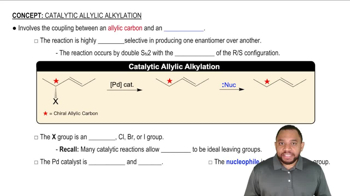
Organozinc reagents, such as the ZnBr-alkene shown in the reaction, are nucleophilic species used in cross-coupling reactions like Negishi coupling. They are known for their relatively mild reactivity and compatibility with a wide range of functional groups. In the reaction, the organozinc compound donates its organic group to the palladium catalyst, which then couples it with the organic halide to form the desired product.
추천 영상:
01:52
Reagents