

Fluoxetine, an antidepressant, is better known as Prozac®. Suggest reagents that could be used to make the indicated C–O bond of fluoxetine. [Note that CF3, an electron-withdrawing group, is para to where the new bond will be formed.]
Ch. 23 - Benzene 1: Aromatic Stability and Substitution Reactions

Mullins1st EditionOrganic Chemistry: A Learner Centered ApproachISBN: 9780137566471당신이 사용하는 게 아니라요?교과서 변경
22장, 문제 85
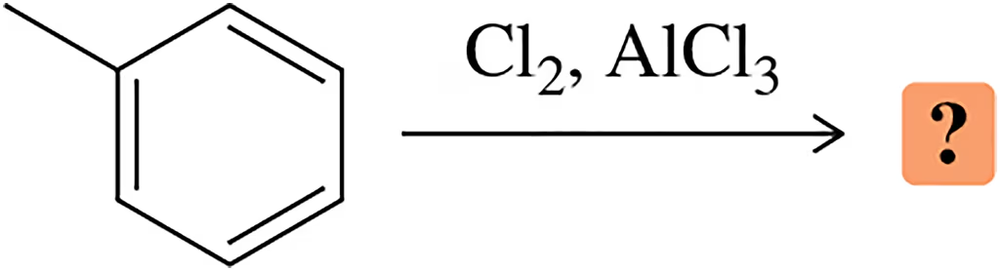
How might you use 13C NMR spectroscopy to differentiate between the possible ortho, meta, and para products of the electrophilic aromatic substitution reaction shown?

검증된 단계별 안내1
Understand the structure of ortho, meta, and para substituted benzene rings. In ortho substitution, the substituents are adjacent, in meta they are separated by one carbon, and in para they are opposite each other on the benzene ring.
Recognize that ¹³C NMR spectroscopy provides information about the carbon environment in a molecule. Each unique carbon environment will give rise to a distinct signal in the ¹³C NMR spectrum.
For the ortho product, identify that there will be more unique carbon environments due to the proximity of the substituents, leading to more signals in the ¹³C NMR spectrum.
For the meta product, note that the substituents are separated by one carbon, which will result in a different pattern of unique carbon environments compared to the ortho and para products.
For the para product, observe that the symmetry of the molecule will result in fewer unique carbon environments, leading to fewer signals in the ¹³C NMR spectrum compared to the ortho and meta products.

비슷한 문제에 대한 검증된 영상 답변:
이 영상 해법은 위 문제에 도움이 된다고 튜터들이 추천한 것입니다.
주요 개념
질문에 올바르게 답하기 위해 반드시 이해해야 하는 핵심 개념들은 다음과 같습니다.
Electrophilic Aromatic Substitution
Electrophilic aromatic substitution is a reaction where an electrophile replaces a hydrogen atom in an aromatic ring. Understanding the positions of substitution (ortho, meta, para) is crucial, as they affect the chemical environment of the carbon atoms in the ring, which can be detected using ¹³C NMR spectroscopy.
추천 영상:
EAS Review
¹³C NMR Spectroscopy
¹³C NMR spectroscopy is a technique used to observe the carbon atoms in a molecule. It provides information about the chemical environment of each carbon, which can help differentiate between ortho, meta, and para substitution patterns in aromatic compounds based on the distinct chemical shifts and splitting patterns of the carbon signals.
추천 영상:
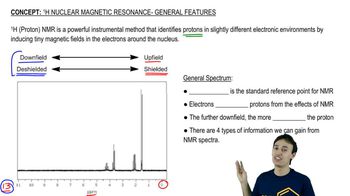
General NMR Features
Chemical Shift and Splitting Patterns
Chemical shift refers to the position of an NMR signal, influenced by the electronic environment surrounding a nucleus. In ¹³C NMR, ortho, meta, and para substitutions cause different shifts due to variations in electron density and steric effects. Splitting patterns can further aid in distinguishing these positions by showing how neighboring atoms affect the carbon signals.
추천 영상:
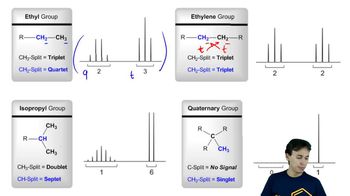
Common Splitting Patterns
관련 실천
교과서 질문
568
views
교과서 질문
Suggest a synthesis of the molecule on the right beginning with the molecules on the left.
919
views
교과서 질문
Would you expect chlorination to occur ortho, para, or meta to the pyridinium ion in the following molecule? Explain your answer.
592
views
교과서 질문
Suggest an arrow-pushing mechanism of the following rearrangement.
919
views
교과서 질문
Addition by the benzyne mechanism is not usually regioselective. Explain the fact that the reaction shown is highly regioselective for the product shown.
382
views
교과서 질문
Acetohexamide is used to treat type 2 diabetes that cannot be well controlled by diet alone. Fill in the blanks of the synthetic scheme used to synthesize acetohexamide. [Hints have been provided below each step.]
461
views
