Ch. 23 - Benzene 1: Aromatic Stability and Substitution Reactions
Mullins - Organic Chemistry: A Learner Centered Approach 1st Edition
Mullins1st EditionOrganic Chemistry: A Learner Centered ApproachISBN: 9780137566471당신이 사용하는 게 아니라요?교과서 변경
22장, 문제 74c

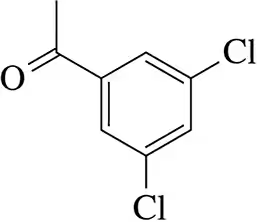
Suggest a synthesis of each of the molecules shown beginning with benzene.
(c)

검증된 단계별 안내
1
Start with benzene as the base molecule. The target molecule is 2,4-dichloroacetophenone, which requires the introduction of two chlorine atoms and an acetyl group onto the benzene ring.
Perform a Friedel-Crafts acylation to introduce the acetyl group. Use acetyl chloride (CH3COCl) and aluminum chloride (AlCl3) as the catalyst to add the acetyl group to the benzene ring, forming acetophenone.
Next, perform a chlorination reaction to introduce the chlorine atoms. Use chlorine (Cl2) in the presence of a Lewis acid catalyst like iron(III) chloride (FeCl3) to add chlorine atoms to the ortho and para positions relative to the acetyl group.
Ensure that the reaction conditions favor the formation of the 2,4-dichloroacetophenone by controlling the temperature and the amount of chlorine used to avoid over-chlorination.
Finally, purify the product using techniques such as recrystallization or column chromatography to isolate the desired 2,4-dichloroacetophenone from any side products or unreacted starting materials.

비슷한 문제에 대한 검증된 영상 답변:

이 영상 해법은 위 문제에 도움이 된다고 튜터들이 추천한 것입니다.

주요 개념

질문에 올바르게 답하기 위해 반드시 이해해야 하는 핵심 개념들은 다음과 같습니다.

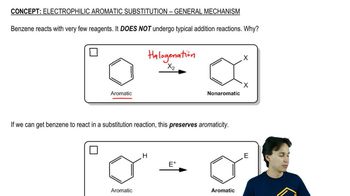
Electrophilic Aromatic Substitution (EAS)

Electrophilic Aromatic Substitution is a fundamental reaction in organic chemistry where an electrophile replaces a hydrogen atom on an aromatic ring, such as benzene. This reaction is crucial for synthesizing various substituted aromatic compounds. The stability of the aromatic system allows for the introduction of different functional groups, which can be further manipulated in subsequent reactions.
추천 영상:
03:07
EAS Review

Reactivity of Benzene Derivatives

Benzene derivatives exhibit unique reactivity patterns due to the presence of substituents that can either activate or deactivate the ring towards electrophilic attack. For instance, electron-donating groups enhance reactivity, while electron-withdrawing groups decrease it. Understanding these effects is essential for predicting the outcomes of synthetic routes starting from benzene.
추천 영상:
02:49
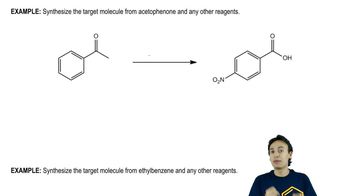
Aromatic synthesis starting with benzene/benzene derivatives

Functional Group Transformations

Functional group transformations involve converting one functional group into another through various chemical reactions. In the context of synthesizing the given molecule from benzene, transformations such as oxidation, halogenation, and substitution are key. Recognizing how to manipulate these functional groups allows chemists to design effective synthetic pathways to achieve desired products.
추천 영상:
02:36
Identifying Functional Groups